Wednesday, November 11, 2015

Sailing to New Zealand- We Visit Wellington, Akaroa, Dunedin, and the Magnificient Fiordland


Our first day at sea was not good. As soon as we had passed the headlands at the mouth of the Parramatta River, the seas started to get rough.
Skyline & Opera House from the river
By the next morning it was worse. We had 25-40 kt. winds with seas around 10-12 ft., but what made it bad was that everything was coming from the north and we were on an ESE course taking those big rollers right on the port beam and rocking the ship back and forth hard. We saw several people with sea sickness and wondered if that might not be misdiagnosed as gastrointestinal illness that had put the ship under norovirus sanitary precautions. We had heard that the staff were not reporting sickness like they often do in a norovirus outbreak.
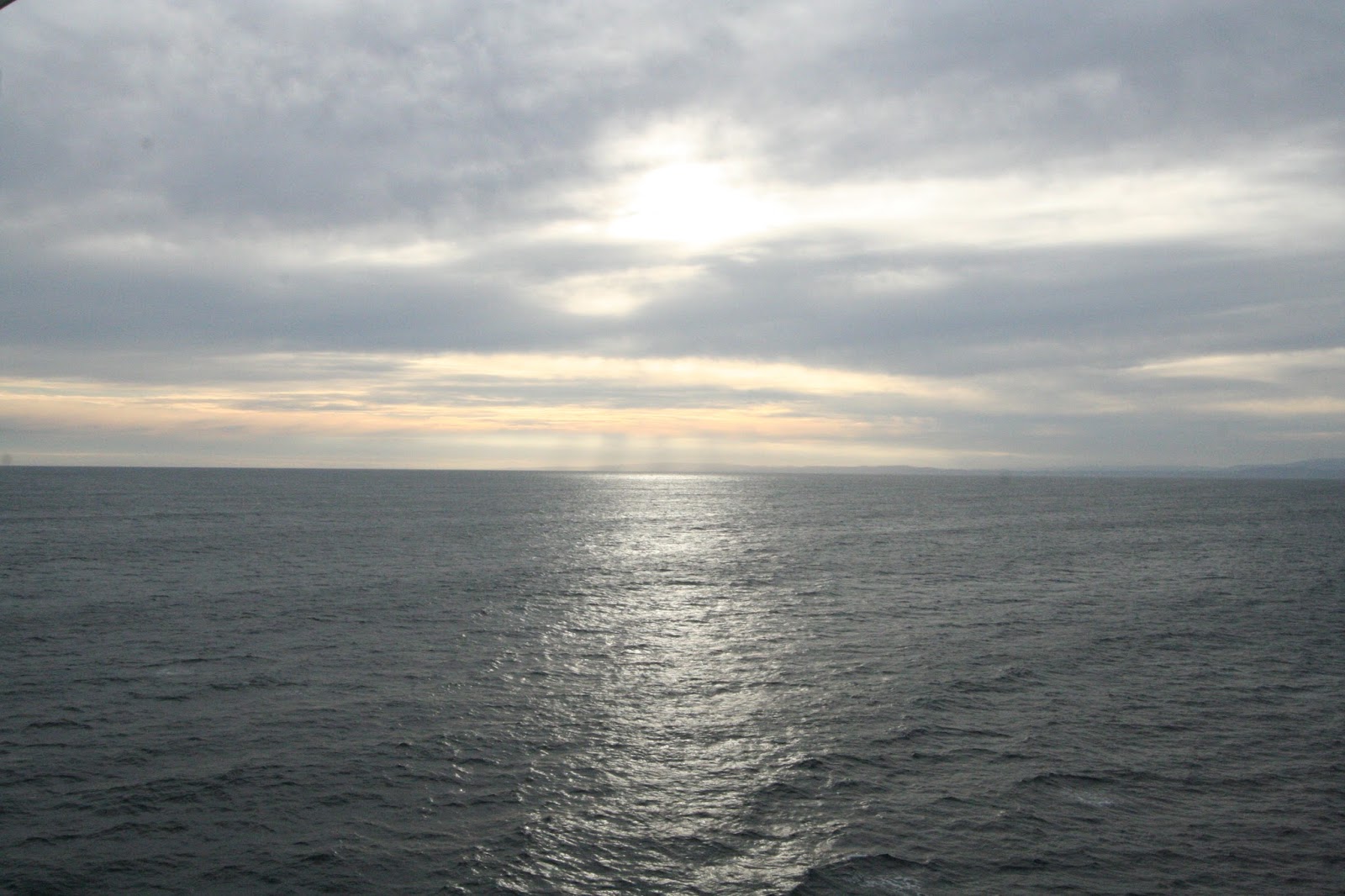
The Tasman Sea was not kind to us
To pass the time we explored the ship and Jane took some craft classes (watercolor painting and jewelry making), while Capt. Larry worked on the blog, organized photos, read, and watched football. These conditions continued into the next day, finally abating by the afternoon of the third day as the cold front passed and the winds shifted to the SSW.
Wellington's cable car
Compared to our crossing of the Drake Passage into Antarctica, we found the Tasman Sea to be far more challenging. Of course, we also realize that we were really lucky in the Drake Passage.

The morning of our arrival into Wellington, we were once again experiencing really lousy weather and seas. It was cloudy and raining with winds running 20-30 kts. and 7-10 ft. seas, but with the waves coming right on the bow, the ride was relatively smooth.
Overview of Wellington and its harbor
Overall it didn’t look like a very good day to sightsee Wellington. New Zealand’s capital, Wellington is often compared to San Francisco for its many hills, cable cars, and narrow streets lined with Victorian homes.
Pubbing with Keith & Sheila
We didn’t purchase a shore excursion for Wellington, deciding instead to take the shuttle down to the central business district where we could catch a cable car to the trendy hilltop suburb of Kelburn for a view of the city and its beautiful harbor.
The rain had stopped as we were docking and we started to think that the day might be somewhat pleasant, but that hope was dashed with the rain returning as we disembarked.
Akaroa Harbor
Jane struck up a conversation with two Aussies, Keith and Sheila, who she became acquainted with in her painting class. As we were standing in line awaiting a shuttle, it started raining really hard and we were getting soaked.
Tendering into Akaroa
The 50-degree temperatures and very windy conditions only compounded the misery. We exited the shuttle and found the cable car that would take us on a 5-minute ride to Kelburn. At the hilltop we found a restaurant and decided to have some beers. We took some photos of the city and harbor and descended to the business district. Keith asked a local where we might find a pub, and he obliged us with a number of choices (never a shortage of pubs in AUS/NZ!).
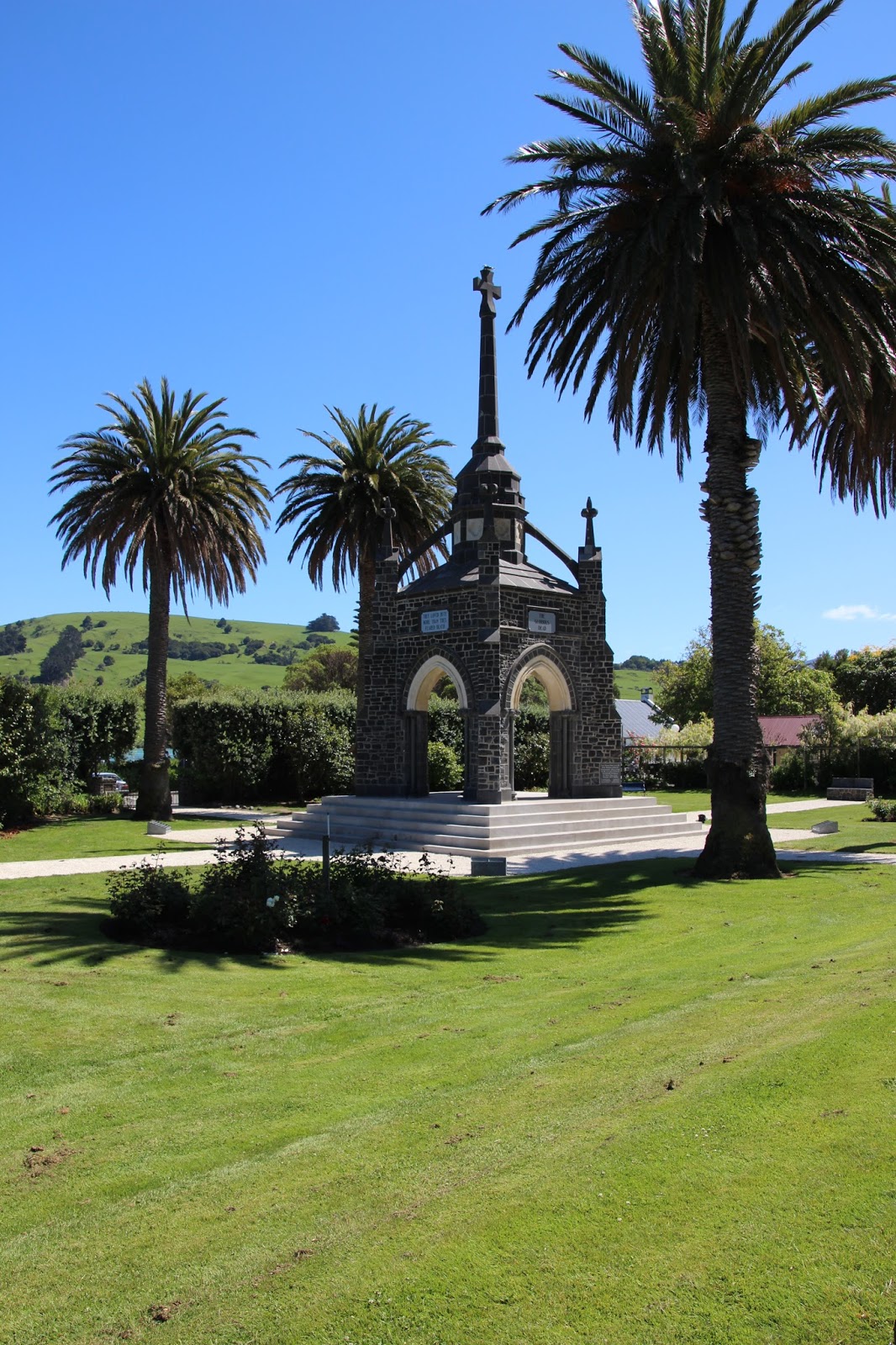
War memorial in Akaroa
We made our way to Monteith’s pub and had some more beers and fun conversation. We were drinking with Aussies, but we really weren’t scared! We found the shuttle pickup point and made our way back to the ship.
Old Catholic church in Akaroa
We didn’t do a lot in Wellington, but considering the weather, we were happy with our time and can also say we’ve been to New Zealand.
The next morning we found the ship anchored offshore in Akaroa Harbour. Today we would be tendering into the town of Akaroa to see the sights. Since none of the ship’s shore excursions excited us enough to purchase them, we would be sightseeing on our own again. After a leisurely breakfast, we gathered our things and proceeded to the tender deck for our boarding and 15-minute ride to the docks.
Akaroa lighthouse and harbor
We were pleased that the sun was shining, the wind had died down, and the temperature was where it should be for this time of year, as this looked like another of the 2 or 3 really great weather days we had seen since we arrived in AUS/NZ.
Pretty flowers in Akaroa

We rode the tender through the placid, picturesque harbor and immediately got the feeling that this was going to be one of those special places we sometimes come upon.
Akaroa sits on the Banks Peninsula, named after the English naturalist Sir Joseph Banks after the first European sighting by Captain Cook in 1770.

The Banks Peninsula was formed following violent eruptions of 3 volcanoes (New Zealand is part of the Pacific Ring of Fire which experiences considerable volcanic activity). Craters from these volcanoes nurse the harbors of Akaroa and Lyttleton Harbours with smaller bays indenting the rest of the coastline.
Dunedin railway station
Originally inhabited by Maori natives, the French captain, Jean Langlois of the whaling ship Cachalot, negotiated with the local Maori chief to buy Banks Peninsula in 1838. Returning to France, Langlois organized a company of emigrants to return to New Zealand and form a colony. However, by the time Langlois and the emigrants returned in August, 1840, the Treaty of Waitangi had been signed and New Zealand became an English colony. Because of these developments, Akaroa still maintains a French heritage.
Coming into Dunedin

After a very short walk along the docks, we found ourselves in the heart of the Akaroa business district. Walking along the harbor’s edge, we found numerous bistros and cafés, gift shops, outfitter and adventure establishments, and hotels and restaurants all catering to the tourist. Sheep farms sprinkle the hillsides surrounding Akaroa, and industrial jobs can be found in Christchurch about a 1.5 hours’ drive away, but tourism seems to be the anchor or Akaroa’s economy.
Old Dunedin prison
We left the central area and walked along the harbor’s edge until we came to a memorial we believe was dedicated to those who died in war (there were no signs or plaques indicating the structure’s purpose, just names engraved on the walls of the memorial). Moving on we entered the traditional French area of the town replete with French flags, signs, and various French businesses.
Getting that good spring water
We found a postal substation, so we bought some postcards and mailed them. We walked to the end of town then made our way back through the central business district and on to a lighthouse at the other end of town. Having seen about everything that had been mentioned in the shore excursion guide, we returned to the dock and caught the next tender back to the ship.
Copper fermenting vats
Akaroa was a quaint, charming little village and one we could envision returning to for an extended stay.
During the evening the ship was repositioned to our last New Zealand port of Dunedin. Although the Otago Peninsula, on which Dunedin is situated, had early European inhabitants from whaling and sealing interests, it was the arrival of Presbyterian Scots escaping religious persecution in 1848 that gave rise to the settlement.
Line 'em up. We're ready for a taste!
Named Dunedin, Scottish Gaelic for “Edinburgh on the hill,” the town was designed to resemble the capital of Scotland. The discovery of gold in the surrounding rivers and hills brought the town tremendous wealth that is reflected in the opulent Victorian architecture found throughout the city.
Our ship passed through a relatively narrow channel, lined on both sides with mud flats and wading birds, to get to the terminal. Because Dunedin was so far from the terminal (we went as far as we could go), we purchased a shore excursion to maximize our time in the city.
In the Guiness Book of Records
We boarded our bus and were whisked off to begin our tour. We were taken to a park overlooking the city and harbor for a photo shoot, and then off to Speight’s Brewery for a brewery tour. Speight’s is New Zealand’s largest brewery, but very little of its production is exported (except to Hawaii and Fiji).
One steep baby!
Deciding to expand operations, the canning and bottling operations were moved to Christchurch with the intention of expanding exports. In 2011 an earthquake hit Christchurch and destroyed all of the brewery’s infrastructure setting these plans aback. However, recent wins in beer competitions in Colorado and Germany has the company on track to expand exports.
In the botanic garden
As a community service, Speight's shares the spring water the brewery sits upon with the public, and locals can be seen filling water bottles at a tap located outside the brewery walls. We viewed the equipment used to brew the beers and then headed to the bar to sample their products. According to Capt. Larry’s palate, all of the brews were quite excellent in their own category.
Cloudy sunset leaving Dunedin
His recommendation is that if you happen to see Speight’s at your local beer mart, give it a try. You probably won’t be disappointed.
Dunedin headland and lighthouse
After the brewery tour, our driver took us to Baldwin Street, “the steepest street in the world.” And it was STEEP. So steep that it’s hard to imagine how anyone can navigate it.
Entering Dusky Inlet
We took some pictures while some crazy Chinese dudes started charging up the hill to see how far they could get. It wasn’t far! Next we rode to the Octagon, Dunedin’s central business district. With $100 NZ remaining in Kiwi money and only 30 minutes before we moved on, Capt. Larry charged Jane with the task of buying some souvenirs.
Dusky Sound
Jane, not used to shopping hurriedly, almost cracked under pressure!
Beautiful Dusky
Down to her last $7 and spotting something that cost $10, a vendor in an open air market took pity on her and made her a deal. Our last point of interest was Dunedin Botanical Garden. Being spring everything was blooming.
Entering Doubtful Sound
Ready to view the sounds
Our time was limited, but we snapped as many photos as we could. We were returned to our ship and spent the rest of our afternoon relaxing.

We left Dunedin and traveled through the night arriving at New Zealand’s famed Fiordland National Park.
Located on New Zealand’s southwestern tip, the park covers 3.1 million acres (nearly 5% of New Zealand’s land area), is a UNESCO World Heritage Area, and is home to 14 spectacular fiords along New Zealand’s rugged west coast.
Doubtful Sound
Beginning 500 million years ago, intense heat and pressure deep in the Earth’s crust formed gneiss, schist, and granite rock that was thrust upwards by folding of the Earth’s crust. In the past two million years glaciers have periodically covered the area gouging, deepening and rounding the U-shaped valleys that are now the park’s fiords and lakes.
Another shot of Doubtful
The park’s 14 fiords reach up to 25 miles inland and extend along 125 miles of rugged coastline.
The park’s climate is typical of a temperate rainforest with up to 300 inches of rain annually with flora and fauna typical for such an environment.
Sheer granite peaks of Milford
This heavy rainfall creates a unique marine environment with a 130 foot layer of freshwater lying upon the sea water within the fiords in which virtually all marine life is found. Originally, the area was inhabited only by birds, plants, and trees.
Breathtaking Milford Sound
However, non-native species introduced by European settlers upset the balance and 50% of native species were wiped out.
Today we are very fortunate to visit 3 of the sounds- Dusky, Doubtful, and Milford. Although they were classified and named as sounds by Captain Cook and his crew in 1773, scientists recognize they are truly fiords, but Cook’s categorization remains since that was the name first laid down on nautical charts.
Milford Sound
We entered Dusky Sound just after 0800. The views were breathtaking.
Steep peaks and drizzle in Milford
The sounds are all noted for an abundance of wildlife, but we didn’t see any evidence of this in any of the sounds; just the beauty of the towering peaks rising from the crystal blue water and waterfalls tumbling back into the sea.
One of Milford's many waterfalls
After making our way through Dusky Sound, we returned to the fury of the Tasman Sea with 20-25 kt. winds and 10-12 foot seas. Around 1030 we tucked into the inlet of Doubtful Sound and into sheltered, calm conditions. And spectacular scenery again. While different, Doubtful was just as remarkable as Dusky.
Jane & Milford's Elephant Falls
Doubtful is best known for its black coral trees which occur in unusually shallow water for what is normally a deep water species. We left Doubtful and sailed back into the Tasman tempest, on our way to Milford Sound, the crown jewel of Fiordland. Arriving at the Milford inlet around 1500, we were stunned by the raw, unspoiled beauty that looked like a sculpted work of art.
Tourist boat at a Milford waterfall
Milford receives the largest amount of rainfall and is adorned by an assortment of magnificent waterfalls. We followed the fiord to Elephant Falls and the town of Milford, a small community with a hotel and home base to a number of sound tours.
End of the road- the town of Milford
We couldn’t navigate the sound any further so we turned around and headed back to the Tasman Sea where we set a WNW course for Melbourne, Australia. Our captain, Master Juan “Hell-bent” Carangid, announced that a low pressure system would descend upon us during the night and we would experience worsening conditions with northerly winds to 50 kts. and 12-14 ft. seas. Somehow the weather forecast didn’t seem to cause “Hell-bent” to slow down and we rock and rolled all through the night while maintaining our course and 18-19 kt. speed for Australia.
 

Tuesday, November 10, 2015

Re-exploring Sydney and an Aussie Oktoberfest


St. Mary's Cathedral
Neo-gothic spires
Our flight from Ayers Rock to Sydney took us back through Alice Springs. We arrived in Sydney and proceeded to the meeting point to catch our shuttle. However, our driver wasn’t there. After 15 minutes a group of 12 people who were using the same shuttle had assembled, and 3 couples from Florida started to become quite agitated and vocal about the missing driver. Capt. Larry called the bus company, but it was past their closing time. Compounding the situation, the emergency number that was given wouldn’t connect. Capt. Larry suggested that we just wait, the driver likely was caught up in Friday afternoon rush hour traffic, but that did little to quell the emotional pitch and started to make him a target for their anger. After 45 minutes of waiting the driver finally appeared, but at first it seemed like he didn’t have enough room for all of us (he seemed Balkan in descent and didn’t speak English very well). Somehow his appearance didn’t stop the bitching. After 15 minutes of phone calling, he led us out to his van which had seating for 13 people! This really got the Florida folks in a lather. We were finally delivered to our hotel, got checked in, and had a couple of good stiff drinks to put an end to a wearisome day.

Rubbing the hog's nose for luck

The next morning we went out for our morning walk. Our tour of Sydney on our previous visit had taken us into the Hyde Park and The Domain areas of the city to view some attractions there. Since it was within walking distance, we thought we would stroll through these areas again and take some pictures of what we only had fleeting glimpses previously. In Hyde Park we found the beautiful St. Mary’s Cathedral and surrounding plaza. The blooming trees and beds of flowers reinforced that spring was here. We admired church’s beautifully ornate stonework on the entrance façade and the gothic spires.
A little pricey on the parking

Cactus in the Garden
The plaza showcased a spectacular fountain. We walked on toward The Domain and noticed a large, fenced-off area with a German beer hall, beer stands, and 3 stages for bands. A sign told us that Sydney was in the midst of celebrating a German Oktoberfest which would open at 1400 that afternoon. We immediately knew what we were going to do the rest of the day and where we would be eating. We entered The Domain and into the Royal Botanical Garden to return to our hotel room. We repacked our suitcases while we were waiting for the opening of the Oktoberfest grounds and got ourselves all ready to transfer to our cruise ship tomorrow. Capt. Larry found an e-mail from the cruise line that changed our check-in time from 1100 to 1230.
One more shot of the Opera House
This change was to allow the ship’s crew to perform an enhanced sanitation due to an outbreak of several cases of gastrointestinal illness during the last cruise, and they didn’t want the guests to be arriving early and congesting the terminal area. We would have to ignore this last minute notification as our hotel checkout time was 1100 and we had already changed a transfer time to coincide with our checkout. They would just have to deal with us.

We returned to the Oktoberfest grounds, bought tickets, and headed over to a beer hall to hear a really good German band.
A large crowd at Oktoberfest
Practically everyone was dressed in German clothes and the crowd was very young, but very enthusiastic, and everyone was having a good time.
Filling the beer cups
The band finished and we decided to find something to eat. There were several offerings to choose from, but we opted for fare from one of the several sausage huts. With a German kransky, an Oktoberfest bratwurst, a second soft pretzel, and a Weihenstephan beer, we found a table to eat our meal. It was delicious!
Pretty young fraulines
After we finished, we explored the rest of the grounds to see what else we might enjoy, but we found mostly port-a-potties (they call them dunnies) and beer stands with really long lines. We returned to the beer hall to listen to the music and watch the kids party.
Prosit!!
Given our age relative to that of the group, we were slightly out of place, but the young people kept approaching us and toasting as a sign that we were accepted. It was fun.
Mmmmm!! Sausages!!
When the band finished its set, we headed back to our hotel for our last night in Sydney.


The next morning Capt. Larry wanted to go for a walk. Jane’s feet were hurting from all of the walking we’ve been doing, so he headed out for the usual 1.5 hour, ~5 mile walk. Trying a different route, he walked along the circular quay that ran along the harbor and figured that the road would make one large circle and bring him back to the starting point. After following the route for about 75 minutes, he came upon a container cargo wharf and a defunct terminal tower that he recognized from the first day’s Sydney tour as being in the Bangaroo section of the city.
Our ship coming to get us
Looking up, he recognized none of the buildings or skyscrapers that had become familiar landmarks around our hotel. He was lost. He stopped a local and asked for directions, but the guy only had a vague idea as to how he should proceed. He continued until he came to an intersection that allowed him a 90° change in course. Still nothing looked familiar. Finally, after a couple more course alterations he came upon a clock tower that he had passed yesterday on the way to the Oktoberfest. He figured he needed to go south, so with the sun rising on his left he was headed south. After walking for another 15 minutes, he realized that things should be getting familiar, but they weren’t. Confirming with a street vendor that he was headed south, he was told that he was going south, but the hotel and cruise terminal were in the other direction, “a 10 minute’s walk from here.” Twenty minutes later he was back at the hotel after walking over 2 hours. Does aging reduce one’s sense of direction?

We checked out of our hotel and met our driver who took us to the terminal. We were able to check our large bags. We walked along the quay and found a nice shady spot to sit and await our check-in time, boarding, and departure.

Wednesday, November 4, 2015

Uluru, Kata Tjuta, Walpa Gorge, Black Flies and Those Crazy Drinking Aussies!


We arose early again (having trouble sleeping in on this trip) and had a whole morning to catch up on things before our afternoon flight to Ayers Rock. The hotel we were staying in had a good internet connection, so Capt. Larry worked on uploading a couple of posts to the blog while Jane did whatever Jane wanted to do. After lunch our driver arrived and took us to the airport for the short flight to Ayers Rock.

Arriving at Ayers Rock Resort, we found the weather to be very much like that in Alice Springs- very hot, very dry, and very sunny. We are in the desert. We checked into our hotel and decided to take a short walk to the resort square to scout things out. There were three restaurants, a coffee café, gift shops, mini-supermarket, post office, and a bank. AccorHotels, the French hotel conglomerate that formerly owned Motel 6 and Red Roof Inns in the U.S., owns everything (except the bank and post office of course). In fact, we were told that Accor bought up all of the hotel properties in the resort and has a major interest in the tour operations. Ayers Rock Resort is located about 10 miles from Uluru and surrounding attractions, and originally all of the hotels, restaurants, and an airstrip were actually located at the rock. This changed around 2000 when the aboriginal people regained access to the lands which they consider sacred. Everything as then moved to the present location in the town of Yulara, making Yulara the fifth largest town in the Northwest Territory (NT) with a population of around 1,200! You get the idea the NT population density (0.4/sq. mi.) is low when you consider there are around 250,000 people spread over approximately 500,000 sq. mi.

We returned to our room and started to get ready for our first tour event, Sounds of Silence, a dinner and Australian barbecue “under the sparkling outback sky.”
Dinner under the clouds
However, we judged by the looks of the sky that there wasn’t going to be much sparkle as thick clouds had moved in during the afternoon. A short shuttle ride brought us to a sand dune set up with an outdoor kitchen and tables laid out for dinner. We walked to the top of the dune and were served wine and canapés. We mingled with some Australian and American couples who turned out to be our dinner companions. We were supposed to be treated to vistas of Uluru and the domes of Kata Tjuta (KA ta JEW ta), the vast surrounding landscape, and the most spectacular sunset we had ever seen, but the clouds wouldn’t let that happen. No problem, the wine was working and dinner was ready. Our barbecue buffet of authentic Australian delicacies included barramundi (a very delectable fish), kangaroo, emu, crocodile, bush salads and sides, and wonderful desserts.
We even had music (noise?)!
And the fine Australian wine kept flowing. The resident astronomer was supposed to take us on a tour of the southern night sky, but the clouds allowed more time for drinking wine (it all works out!), tea, coffee, and port. Billed as the Sounds of Silence, the dinner was anything but silent given the few abstemious souls and the carousing nature of the roisterers. We returned to our hotel and crashed for the night.

The next morning we dragged ourselves out of bed at 0400 so that we could catch a 0500 bus that would take us out to Uluru for a sunrise viewing experience. We got ready and walked out of the room only to find that it was raining (it’s spring and rainy season).We had some doubts that this was going to come off as planned.
Uluru at daybreak
However, our guide tried to convince us how lucky we were, because only about 1% of visitors get to see Uluru in the rain. Some luck. Uluru and Kata Tjuta are contained in a national park, but a 12-member council equally divided among non-aboriginal, aboriginal male, and aboriginal female (there are sites in the park that are devoted strictly to women) members make decisions as to how the park will be accessed and utilized.
The breakfast bus
Since a unanimous vote is required for changes to occur, not much is ever changed. We entered the park as the rain stopped, drove to a roadside pullover, and waited for the sun to rise. Our guide served us a continental breakfast and we waited. And waited. Sunrise came according to the clock, but the heavy clouds blocked didn’t show much change in the amount of light.
It says- "Meet me here at noon, Tom"
We were supposed to witness the dramatic color changes the rising sun produced on Uluru, but the diffuse light didn’t have the punch to do that. About an hour after sunrise we loaded up the bus and headed to the Mutijulu (MU ti JOO loo) watering hole. Uluru has 8 watering holes that collect rainwater. All holes were used by the natives, but the Mutijulu hole was the most reliable. The availability of water also attractsd various game animals which were hunted by the natives.
The rock near the Mitijulu hole
We viewed some cave or rock paintings that our guide said were used to teach children. We drove around the rock to where the hotels and air strip used to be and saw the path that climbers use to ascend Uluru (an effort is underway to stop these climbs). Capt. Larry thought a climb might be a good bucket list item, but Jane would have no part of it.
Our photo of "Big Red"
We returned to our hotel, had some lunch, and prepared for our afternoon tour of Kata Tjuta and the Valley of the Winds.

Did we mention the flies were bad?
We traveled to Kata Tjuta where our guide explained the geological history of these rocks. In a nutshell, Uluru and Kata Tjuta were formed from the uplifting or epeirogeny of alluvial fans. Uluru was formed from the sedimentary deposition of fine sediment, while Kata Tjuta more coarse sediment.
At Walpa Gorge
When the epeirogeny occurred, Uluru emerged as a single monolith while Kata Tjuta, being from coarser origin, developed in to a field of very large boulders and domes. That’s the science, but the natives have their own version and we listened to the stories they hold about the rocks formation. We started our 2-3 hour, rocky walk through the formation, a walk requiring a good level of fitness and one that had Capt. Larry swooning all over the place, until we came to a dead end. The path we were to follow was closed by the rangers due to the high 97° heat.
Food, drink, and flies
Seems the extended walk in these conditions causes many hikers to experience dehydration and heat stroke. We thought we were going to get to go back to the hotel, but the guide, not wanting to cheat us, announced we were going to nearby Walpa Gorge. At the first stop along the trail we decided to leave the group and make our way to the end, rather than listen to all of the cultural talks our guide had a penchant for giving.
Kata Tjuta at sunset
This tactic made us the first to return to the bus. After the rest of the group joined us we drove to a rest area to view the sunset and have some more wine and canapés. By this time the clouds had lifted and we finally had some dramatic views of the rocks in the changing sunlight. Then again, it could have been the effects of the wine. With everyone feeling great, we boarded our bus and headed home. Our guide played some Aussie drinking songs and with the help and encouragement (little was really needed) of some Aussie tourists, the bus was really rocking. Jane had seen an Aussie with a soccer shirt with Holden on it.
Just thick!
She told him it reminded her of home (we live near Holden, LA). He kept filling her wineglass and was the major leader in the singing.
Crazy Holden!
At the first hotel we stopped at he jumped up and yelled “PUB,” and half the bus jumped up and followed him off. He tried to get us to go, but Jane was already pretty far gone and we had a flight back to Sydney tomorrow. Prudence prevailed over temptation and we returned to our hotel. We were very happy of the choice we made the next morning.

Our flight from Ayers Rock to Sydney took us back through Alice Springs. We arrived in Sydney and proceeded to the meeting point to catch our shuttle. However, our driver wasn’t there. After 15 minutes a group of 12 people who were using the same shuttle had assembled, and 3 couples from Florida started to become quite agitated and vocal about the missing driver. Capt. Larry called the bus company, but it was past their closing time.
Our hotel- Sails in the Desert
Compounding the situation, the emergency number that was given wouldn’t connect. Capt. Larry suggested that we just wait, the driver likely was caught up in Friday afternoon rush hour traffic, but that did little to quell the emotional pitch and started to make him a target for their anger. After 45 minutes of waiting the driver finally appeared, but at first it seemed like he didn’t have enough room for all of us (he seemed Balkan in descent and didn’t speak English very well). Somehow his appearance didn’t stop the bitching. After 15 minutes of phone calling, he led us out to his van which had seating for 13 people! This really got the Florida folks in a lather. We were finally delivered to our hotel, got checked in, and had a couple of good stiff drinks to put an end to a wearisome day.