Friday, January 8, 2016

The Windward Islands of Barbados and Grenada


Another overnight cruise and we wake up in Barbados. Bridgetown is the port-of-call and the capital of Barbados. Barbados gained independence from the British in 1966, but their influence is still apparent
St. Mary's church
on the island. English is the native tongue, Cricket is the national sport, and tea is still the favorite drink.
The cricket museum
Of the Windward Islands, Barbados is the furthest east, and was officially named by the Portuguese in 1536. The British arrived in 1625 (Portugal had pretty much abandoned the island) and serious settlement began a few years later. Today Barbados is a proud member of the British Commonwealth of nations and one of the premier tourist destinations in the Caribbean.
Like the other ports we had visited, we decided to shun the shore excursions and explore Bridgetown on our own. The problem was we exited the cruise terminal and got lost.
Parliament building (really!)
The central business district and shopping area was about a mile from the terminal and we felt the walk would do us good. But we started to follow the taxis thinking they were heading where we wanted to go. Wrong!
St. Michael's cathedral
These taxis were taking visitors on island tours and away from where we wanted to go. After waking almost two miles in the wrong direction, we asked a local which direction we needed to go. “Turn around and straight ahead,” we were told.
Very old crypt at St. Mike's
About 2 miles later we arrived at St. Mary’s Anglican/Episcopal church on the outskirts of the central business district. Dating back to 1658, it is the island’s first permanent church and is referred to as the “Old Churchyard.”
Christmas trees and museum
Like many such establishments, the church is steeped in island history. We left the church and walked through the business district with its plethora of tourist jewelry shops. Walking to the National Heroes Square, we crossed the street to the Parliament buildings and neighboring museum. Two blocks past the Parliament buildings and we were at St. Michael’s Cathedral. Built in 1789 of coral stone, the church features stunning stained glass windows.
Chamberlains Bridge
Walking the canal and boardwalk
We took pictures of the sanctuary and cemetery and found some very old graves dating back to the 1700’s. Leaving the cathedral, we walked across the bridge that spans the harbor’s Inner Basin and found a park that was decorated with Christmas trees from local schools. We crossed back into the central business district over another bridge, the Chamberlains Bridge.
Christmas mannequin
Those were the only bridges that we saw but apparently are enough to give the city its name.
A Barbados pirate!
We headed back to the ship, stopping at some shops at the cruise terminal to spend some money. Diamonds International was calling Jane’s name, and she was able to add to her John Hardy jewelry collections with a new ring and bracelet. Capt. Larry guessed the Dollar Tree gifts didn’t quite fill the bill this season. We also learned that all of her John Hardy pieces are now collector's items.
Barbados sunset
Our next stop was the beautiful island of Grenada (gre NAY da- they are particular about this pronunciation).
St. George's
The island’s capital, St. George’s, is considered one of the most picturesque ports in the Caribbean and there’s no way we could disagree with that assessment.

Lush vegetation, mountainous terrain, and colorful colonial architecture make up the landscape.
Market Hill
Grenada is referred to as the “Spice Island” and is filled with spice trees that make it a leading source of nutmeg, cloves, ginger, cinnamon, and cocoa. These trees add a very pleasing, distinct aroma to the atmosphere.
With the Insignia, again
Grenada lies on the southern edge of the Grenadines, and the country is comprised of the island of Grenada and some smaller outlying islands with Carriacou and Petit Martinique the most significant.
We left the ship and headed for the Market Square, the heart of Grenada’s commercial center. Once used as a place for public executions, trading slaves, and political speeches, the square is today used by farmers and spice vendors to sell their produce to locals and visitors.
A beautiful bay
We walked through the square but were assailed by a horde of taxi drivers trying to get us to purchase a tour of the island. We hadn’t planned on doing anything other than a little local shopping, but one taxi shark amused us with his approach and we ended up in a cab to tour the island.
Overlooking St. George's
And what a tour it was! Grenada’s streets are very narrow and not well maintained (if at all!), and the mountainous approaches are enough to raise your hair. We got to see some beautiful sights, but we could not remember the places we had been. Our driver took us to several bays and lagoons located primarily along Grenada’s western shore.
SGU- how about it, grandkids?
He told us that most of the population resided on the western side of the island, but the eastern (windward) shore was more beautiful and picturesque. It was hard to imagine a landscape more lovely that what we were seeing.
SGU building
We were taken to St. George’s University (SGU) and allowed a campus tour. The university, a medical school only at the time, was a focus of nightly newscasts during the 1983 U.S. invasion of Grenada. The U.S administration of Ronald Regan gave the rescue of American medical students at the university as the reason for the invasion, after a violent coup had toppled the Grenadian government a week earlier.
Windstar ship at sunset
The students were successfully brought to the U.S. and allowed to complete their schooling stateside. Today SGU offers degrees in medicine, veterinary medicine, public health, health sciences, nursing, arts and sciences, and business. We toured the beautiful, modern campus in its idyllic setting, and wished that one or more of our grandchildren would go to college here so that we could come and visit them! Our driver returned us to the shopping district. For a total of $30 plus a $5 tip we had a 1.5 hour tour that showed us some of the island’s highlights. This compared to the three-hour, $79 per person shore excursion offered by the ship. We picked up a few small items from the street vendors and re-boarded the ship.

Wednesday, January 6, 2016

New Tropical Destinations- St. Barts and Martinique


Big yachts in St. Barts harbor

Arriving at Gustavia, St. Barts, we were awestruck by the mega yachts that we observed in the harbor as we anchored. The information sheets and reviews we read about St. Barts was that it was a playground for the rich, and from our observations of the surrounding harbor and countryside, we had no reason to doubt it. Finishing our breakfast, we got ready to tender into the port of Gustavia. And it was a rough tender in with the heavy swell that made boarding really difficult.
St. Barts red roofs
Approaching the port from the water, we immediately noticed the trademark red roofs of the buildings that stand out against the green hills that arise from the azure water. St. Barts has a definite French lilt with its French speaking people and French signs on businesses and public facilities.
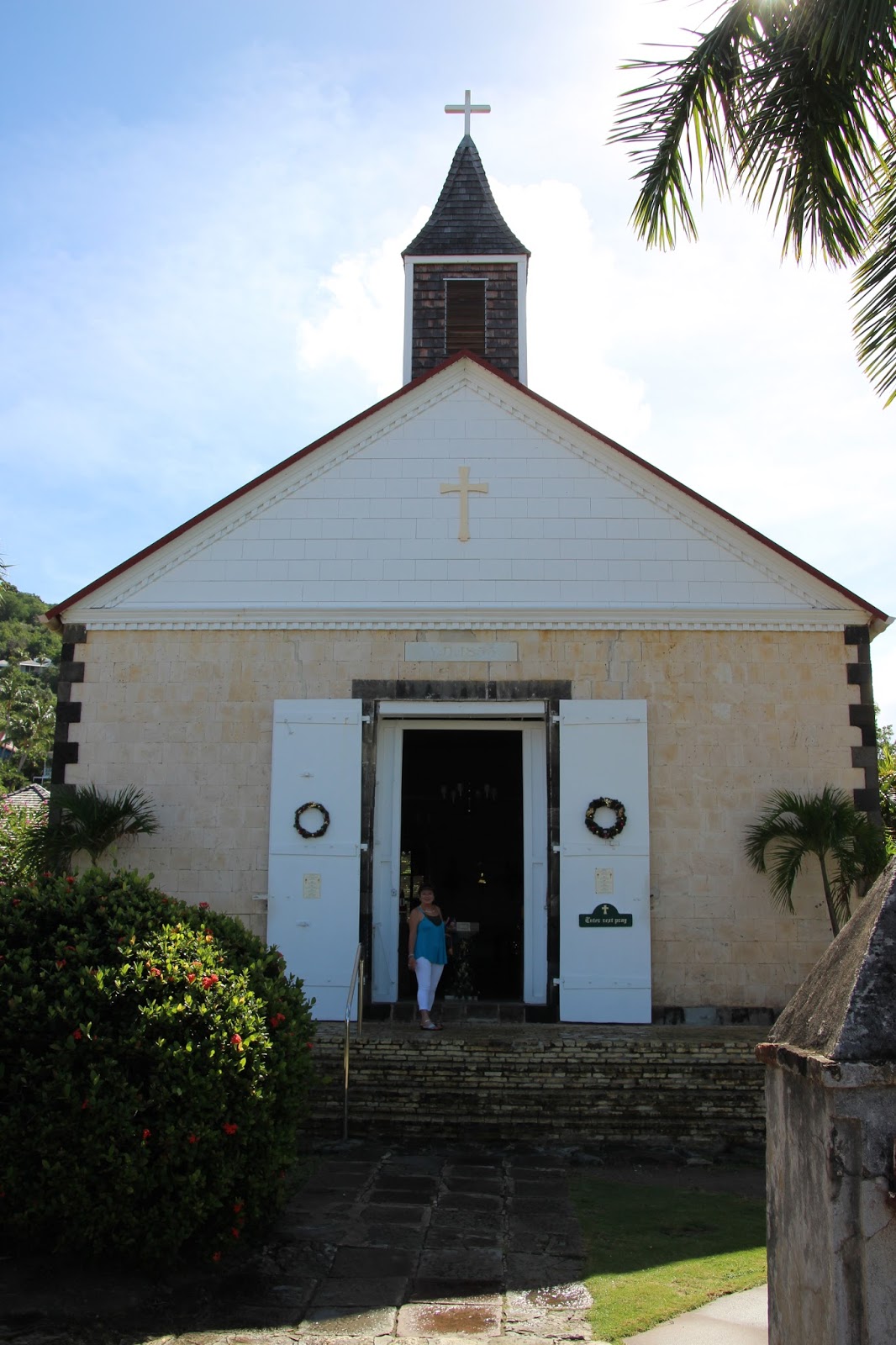
The Anglican Church
First sighted by Christopher Columbus on his second voyage in 1493, the island was eventually settled, after several failed attempts, by French farmers from Brittany and Normandy in the mid 1600’s. We made our way to some of Gustavia’s highlights, struggling to interpret the French map (the arrogant bastards) we were given.
Inside the Catholic Church
Our first stop was the Anglican Church that was established in 1855. Next, we made our way to the Bell Tower. Built in 1799, this is the oldest colonial structure in Gustavia and an example of the town’s Swedish-style architecture. A large clock has replaced the bell. Our last highlight was the Catholic Church, a beautiful structure and grounds.
The Bell (Clock) Tower
Both of the churches were still decorated for Christmas. Our info sheet indicated that there was a beach within walking distance of the tender pier.
Shell Beach
We couldn’t find the beach on the map so we asked a local for directions, and it turned out that it was just a couple of blocks away from the church. We walked to the beach hoping to find a place to sit and have a beer. The beach was named Shell Beach, and it was immediately understood that it got its name from the shells that covered the entire beach. The shells didn’t seem to make very much of the beach usable. We sat down at a beachside café to have a drink only to be told in a heavy French accent that seating was for patrons ordering a meal. There was no way that we were hungry so we left.
Lovin' the tropics
Heading back to the waterfront, we stopped at a waterfront bistro for a beer. Everything in St. Barts is expensive and the beers, at $7 US each, were no exception.
Which one is ours?
Given the Frenchness as priceyness of everything, we drank our beers and decided to tender back to our ship, determined not to spend any more than we had to in an environment where we felt out of place. Walking back to the tender station, we passed a row of moored mega yachts, each trying to outclass its neighbors. St. Barts was an interesting place to say the least.

Fort de France harbor
Another overnight sailing brought us to the island of Martinique, another French-Caribbean island. Martinique has been French with few interruptions since 1635. Right after we docked an announcement was made that Riviera’s sister-ship, Insignia, would be docking next to us. Insignia was finishing a 180-day around the world cruise.
Happy to be here
Wait a minute…..an around the world cruise! Maybe we have a new bucket-list item to think about! Martinique's economy is driven by banana farming, cane raising, rum (there are 12 fine rum distilleries), and tourism. The ship docked at the capital, Fort de France, but we were not optimistic that there would be much activity since it was a Sunday morning and two days after Christmas.

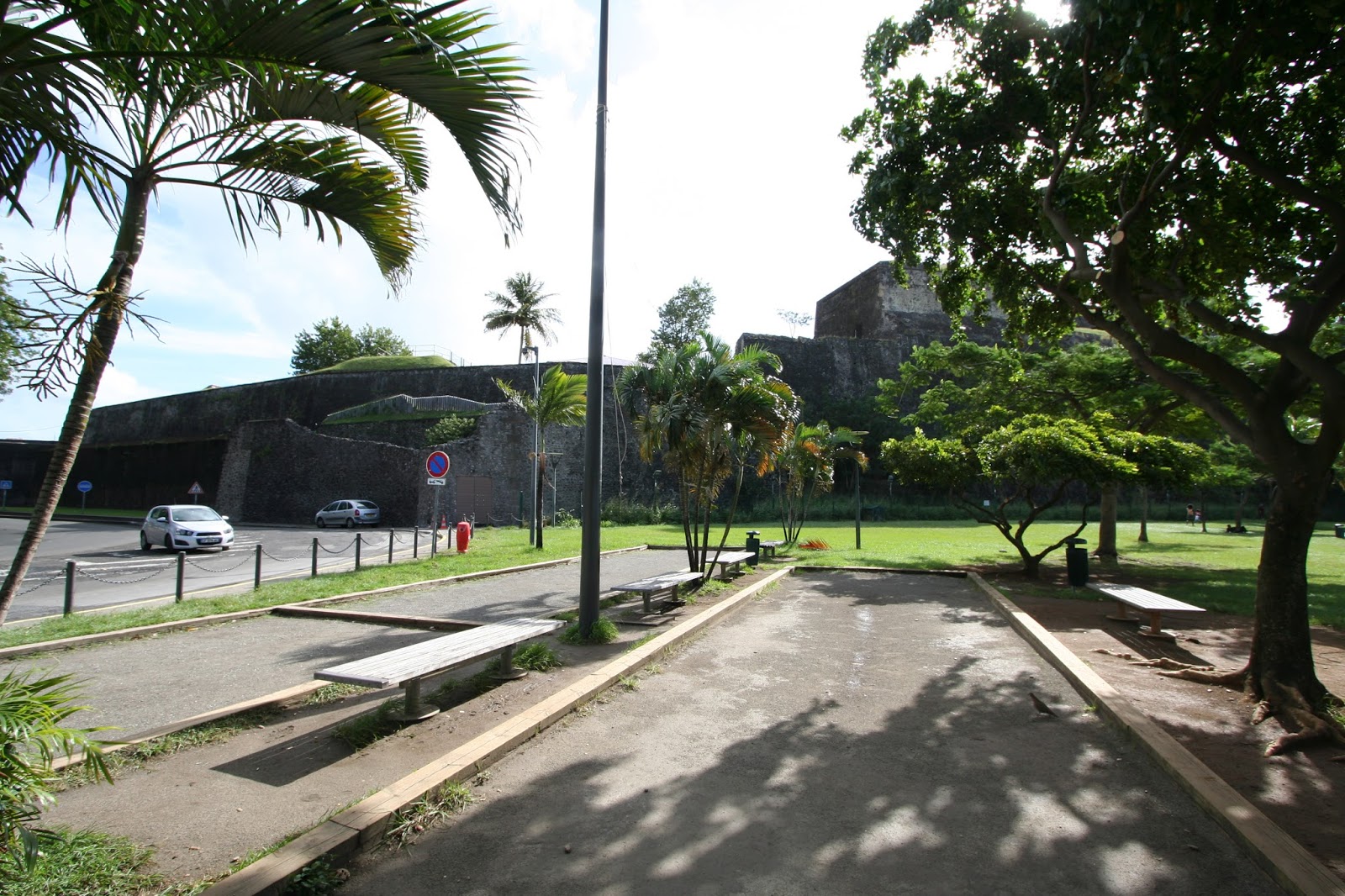
We left the ship and walked along the quay as street vendors were setting up. It was still early. Our first stop was Fort Saint-Louis which is open daily during hours when guided
Fort St. Louis
 tours are offered. We found none to be offered.
Inside the library
The fort was built in stages beginning in 1638 and used to defend Fort de France, and now is a historical site and an active naval base. We weren’t quite sure where we were, but dumb luck brought us to the Bibliothèque Schoelcher or the Schoelcher Library. According to our information sheet, this facility was not open on Sundays, but we arrived and found it open. Go figure. The library was built by the Eiffel Engineering Company and shipped to Martinique in 1893.
Cathèdrale Saint-Louis de Fort-de-France
The library houses over 200,000 volumes. The next thing we found open was the Catholic church, Cathèdrale Saint-Louis de Fort-de-France (don’t you just love French names?).
Colorful street
Since its construction in 1671, the cathedral has been built and rebuilt several times, and we arrived to find it under construction again. We sat in the church for a while, lit a candle for a recently deceased family member, and grabbed a few pictures of this great structure. We had trouble finding a market that supposed to be open until we happened upon one of Martinique’s ambassadors who provided the right route.
Peppers at the farmer's market
However, the market turned out to be a farmer’s market and we didn’t think that we could get any produce items through U.S. customs, so we left and returned to our pier.
Riveria and Insignia
By now the vendors were in full swing and Jane was working her magic. We made some purchases of art items for the house and jewelry items for Jane. We returned to the ship and enjoyed the remainder of the day on our balcony and in art class.

Tuesday, January 5, 2016

Our Winter Escape Continues with a Caribbean Cruise and Christmas in San Juan


Really nice cabin
Cubas's mountains in background
Beautiful sunset
Magnificent sunrise
San Juan building
The next segment of our “Winter Escape” would be a cruise to the eastern Caribbean islands leaving out of Miami just before Christmas. We have cruised the western Caribbean islands several times, and the southern islands once when we went to the Panama Canal, but the eastern islands have never presented themselves as viable destinations, mostly because of their distance from southern Florida ports. Such distances require extended cruise lengths with multiple sea days that are more costly for the cruise lines than port days when the ship is idle, passengers are ashore, and shore excursions can be sold. We considered cruising to these islands from San Juan, PR, but after further research, decided that was not an option for us. We happened upon a 12-day Oceania cruise out of Miami that would visit Puerto Rico, St. Barts, Martinique, Barbados, Grenada, St. Lucia, and Antigua, and cover the Christmas and New Year’s holidays. We had never cruised with Oceania before, but our travel agent assured they were a great line and we found great reviews by other passengers.
The three wise men
Cathedral de San Juan Bautista
Christmas on the balcony
Returning from South Padre Island, we had one evening and one day to do laundry, repack for the cruise, have short visits with family and neighbors, and restock for our post-cruise condo stay in the Florida Keys before heading for Miami. Even though it was crunch time, we made it to the Port Miami Cruise Terminal about an hour before we were allowed to board the ship. We checked in and proceeded with our boarding, only to find the ship amazing. We knew that Oceania was more upscale line, but our ship, the Riveria, far exceeded our expectations. Built in 2010 and christened in Barcelona in 2012 the 1,250 passenger plus 800 crew ship is one of 5 ocean-going vessels Oceania sails to more remote, less visited ports of call. We were able to get settled in just as the ship got under way.
Galleon in the harbor
Inside the cathedral
We had two sea days before arriving at our first port, San Juan, PR, on Christmas. To avoid passing the time eating, we decided to participate in photography and painting classes that were offered. Oceania prides itself on its art and cooking classes that it offers, and we, who already know how to cook, opted for the photo and art classes. Jane attempted water colors before reverting to her comfort-zone acrylics and Capt. Larry decided he would learn to paint with water colors come hell or high water. We came away from the first classes with some great ideas for projects that would be presented to passengers at the end of the cruise. We are on our way to becoming budding artists!
Cathedral nativity
Puppet nativity
Lovin' San Juan
The blue brick pavers
Mimicking the statue
We're joined by other ships
We arrived and docked at San Juan early Christmas morning. As we were waiting to go ashore, we had a coffee and croissants on our balcony and opened our Christmas present from Oceania. Jane also presented Capt. Larry with a gift of cologne. Capt. Larry said he would look for a Dollar Tree to get her something,. After breakfast we disembarked. We had visited San Juan on another cruise several years ago, but it was at night to take on fuel that we had spent dodging a late Atlantic hurricane and we didn’t really get to see much of the city. Today would be different. We began walking the route we had planned to see most of the highlights. Being Christmas day and fairly early in the morning, the city was fairly dead. Walking through San Juan we were struck by the blue bricks that paved the streets. According to the guide book, these blue bricks were used as ballast by Spanish galleons and unloaded before their return to Europe. And there were a LOT of bricks! We made our way to Cathedral de San Juan Bautista. Built in 1540, it is one of San Juan’s oldest buildings and the oldest cathedral. The cathedral is noted for holding the remains of Spanish explorer Ponce de Leon, who accompanied Christopher Columbus when he discovered Puerto Rico. Our timing coincided with Christmas Mass and we sat and enjoyed the service and surroundings. Leaving the cathedral, we wandered into an art gallery that was open and considered a painting for our newly remodeled Florida home. Not being able to decide, we got information for ordering something from the states and having it shipped. We found some more governmental buildings before arriving at the San Juan National Historic Site (Fort El Morro). Although run by the U.S. National Park Service, being a holiday we were unable collect the stamp for this site. We took some photos and started to head back to the cruise terminal. We figured that we had worked up a thirst, so we stopped at a bar for a couple of beers before re-boarding the ship. We sailed away to our next port of call- the island playground of St. Barts.