Tuesday, November 21, 2017

We Start Our Safari at Kruger National Park


We were up early to finish packing our suitcases and have breakfast before heading for the airport to begin the safari portion of our tour.
Our plane
We had a short bus ride to the airport, and a fast group check-in. we were at the gate almost 2 hours before our flight. The skies were overcast and rain was predicted for Cape Town which might help alleviate a very severe drought they were suffering. Our flight would be to the small village of Skukuza located inside the Kruger National Park.
At Skukuza airport
Our accommodations would be at the Lion Sands Game Reserve, a privately owned reserve inside the park. A regional airline would take us to the Skukuza airport.

After landing, the Lion Sands staff quickly collected our bags, and we were whisked off for a 15 minute ride to the lodge.
Collecting our bags
Those 15 minutes stretched into 45, because no sooner had we left the airport than we begin spotting wildlife. A tower of giraffes was spotted grazing tree branches right next to the road.
A tower of giraffes
The cameras were blazing away as we thought this was indeed a unique moment. Turns out that these gentle giants are very common and we would hardly take another picture of them for the remainder of our stay.
A lone elephant
We drove on so the cameras could cool down and 3-4 minutes later a dazzle of zebras was spotted. This is a rarer sighting, but capturing images of these creatures proved a little more difficult as they were more concealed than the giraffes, and they were moving constantly. Their striping in the thicket brush always seemed to conceal as better portion of their bodies making it difficult to get a good shot.
A dazzle of zebras
Driving a little further we spotted a herd of impalas, another animal commonly sighted in the park. More pictures of these which would also be about our last.
A herd of impalas
We drove on, crossing the Sabi River, which has not dried up for over 60 years and is the lifeblood of this ecosystem, and onto our lodge.

A bushbok
Arriving at the lodge we were stunned to find how luxurious the accommodations were in the middle of this rugged environment. Situated adjacent to the Sabi River, the lodge is luxuriously rustic in amenities and is designed for constant animal viewing with expansive, river-facing decks and an elevated walkway to the guest units.
Our bed
We were escorted to an
al fresco lunch on the deck where we enjoyed a fabulous lunch and bushbok and elephant viewing along the river. It was at lunch that we started to establish new friendships as we chatted with our fellow lunch mates.

We were assigned to unit 8 which turned out to be about as far from the main lodge as one can get (we need the exercise!). We entered our unit and our mouths went agape.
Our sitting room
The place was unbelievably furnished: king bed with mosquito netting; two showers (plus another outside) and huge soaking tub (Jane was all smiles); free mini-bar with a liberal stocking of beers, wines, liquors, and mixers (even a fresh lemon!); coffee and tea service and snacks; a private deck and spa overlooking the river; and free Wi-Fi in the middle of nowhere!
Jane's tub
We found all of the furnishings and décor to be elegantly casual and culturally adapted to the locale. But we only had a short time to soak this up as we had to get ready for our first game drive.

Our deck and spa
Reporting back to the main lodge dressed in our safari gear (Jane is so cute!); we found that we would be riding with Dave and Linda from Canada, and Paul and Sharon of New York. Our driver was Mark and our tracker Emanuel, both from South Africa. Two three-hour game drives occur at 0600 and 1600 each day.
The main lodge deck
Each Land Rover Defender can carry 6 guests in a theater seating configuration for best viewing. The drives are conducted on dirt roads maintained in the reserve, with off-road pursuit when an animal is spotted.
Maybe don't need quite that many!
Every drive has a .458 caliber “if all else fails” rifle that he or she must qualify in each year. Drivers and trackers all must pass courses and tests to be certified in their trade.

After introductions were exchanged, Mark gave us a quick rundown of the “do’s” and “don’ts,” all practiced for our viewing enhancement and safety, and we headed out.
Now we're talkin'
Mark was headed for a place where signs of a pack of African wild dogs had been spotted earlier that morning. We got to the spot and did find the dogs, but they were lying around the base of a tree surrounded by thick underbrush.
Lookin' for dem' dawgs
After Emanuel had chopped some of the brush away, we did see them, but they blended into the shadows and none of us could get a good picture. We left after 20 minutes and set out to find something else. Mark told us that the dogs are a rare spot, because of their wide ranging habits, and said that he had probably only seen them perhaps 15 times before.
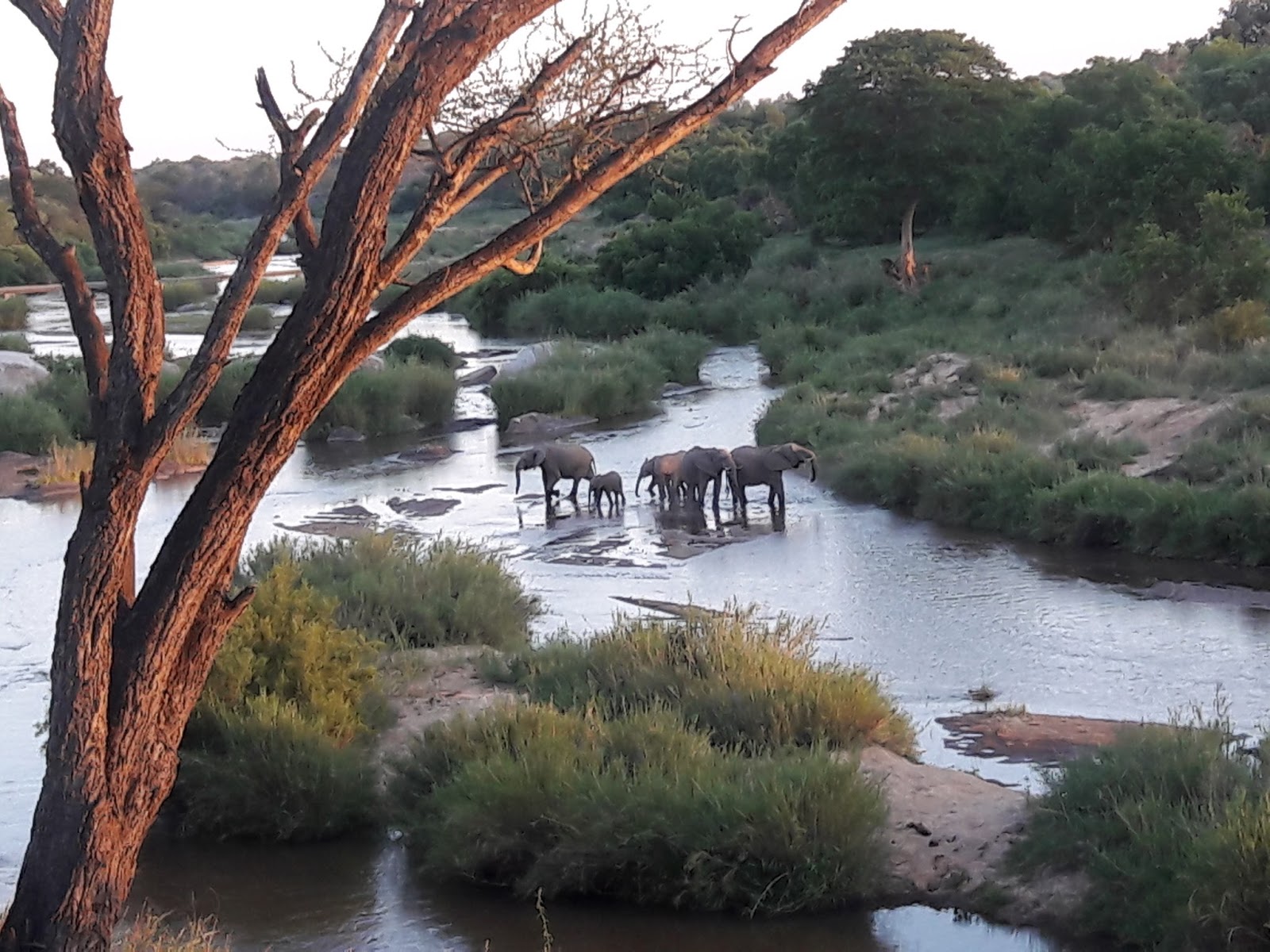
A memory of elephants
We moved on riding a circuitous route along which we saw our first memory of female elephants, some giraffes, and birds that Mark and Emanuel pointed out. Suddenly, Mark got a report on the radio that the wild dogs were on the move. Off we went tearing along to the reported location. Arriving near the location, Mark veers off the road and crashes a trail through the thick brush.
Running African wild dogs
We spotted the dogs running along the river, but they were moving so fast it was hard to keep up with them (they have the advantage in the brush). Another vehicle reported that they left the river and were heading our way. Mark stopped the vehicle and waited. Sure enough, the dogs passed by us on a fast trot.
Ready to start serving
With the cameras in burst mode we shot many pictures, but their speed, the brush, and the autofocus focusing on brush around the dogs only yielded a few fairly good images. But the chase was worth everything! With the sun low in the sky, Mark returned to the road and drove us to his favorite spot for viewing sunsets.
Sunset over Kruger NP
He and Emanuel quickly broke out some liquor and set up a bar on the Rover’s bumper. Emanuel produced some snacks and it was a sunset happy hour. We drank to the sun and the day’s viewing as we watched the sun set. We returned to the lodge and were ushered to dinner replete with dust, sweat, and mosquito repellent, and enjoyed a delicious 3-course dinner on the lodge’s deck. Everyone exchanged stories about the day’s events, and after dessert, we headed to our unit, cleaned up and turned for a fitful rest.

Sunday, November 19, 2017

Apartheid, Dassies, A Wine-Pairing Dinner, Two Capes and Penguins- We Finish Cape Town


Our first day in Cape Town started with breakfast followed by a lecture in the hotel’s library on apartheid. We were vaguely familiar with this topic which made sensational news in the 50’s and 60’s, but as teenagers then, we were thinking more about the opposite sex than racial oppression and protests in South Africa.
The District Six Museum
Our lecturer proved to be very interesting, since he actually lived through this time. Spending 14 years in exile to avoid imprisonment, he detailed the apartheid history and the laws and enforcement that proved to be one of the darker periods in South African history.
Table Mountain
The tour originally had been scheduled for a trip to Robben Island, South Africa’s version of the U.S. Alcatraz, where Nelson Mandela and other black leaders were imprisoned. Even though the island lies only 4 miles from the mainland, the seas in this area are generally difficult to navigate. After a ferry took on water this past summer necessitating the emergency evacuation of passengers, the tour company decided to change the itinerary in the interest of tour group safety. In its place we toured the Sixth District Museum, a museum dedicated to the apartheid displacement of several thousand blacks and coloreds. The museum is located in an old Methodist church and chronicles the government’s removal of blacks and rebuilding the area for white families. While the museum enlightened us on apartheid’s severity, we don’t think it would be as interesting as a visit to Robben Island. We were treated to a quick city tour of Cape Town. Established in the late 17th to early 18th centuries, Cape Town was established by the Dutch West India Company as a refreshment station for ships sailing the long route between the Amsterdam and the East Indies.

A dassie or rock hyrax

We saw many statues and memorials commemorating Cape Town’s history and walked through a botanical park known as the Company’s Garden. While the company originally maintained large gardens to supply the ships, today this park is just a remnant of the original.

View of Cape Town from Table Mt.
No trip to Cape Town is complete without a visit to Table Mountain whose main feature is 2-mile wide level plateau rising 3,563 feet above sea level.
Flanked by the two peaks, Devil’s Peak and Lion’s Head, the formations form an impressive backdrop to the city and Table Bay harbor. A visit to this national park which extends down the entire Cape Peninsula cannot always be guaranteed as the formation orographic clouds often enshroud the mountain, limiting visibility, or high winds can prevent the cable lifts from operating. As we ended our museum tour, our guide decided that conditions then were as good as they might get.
Steenberg Vinyards grounds
We rode to the mountain and took the lift to the top. The views were spectacular, blocked only occasionally by cloud formation. Table Mountain has an unusually rich flora biodiversity with over 2200 species of plants forming part of the Cape Floral Region protected sites, a World Heritage Site. We saw several types of lizards and the mountain’s most common mammal—the dassie or rock hyrax. We descended the mountain and rode back to our hotel to spend an afternoon resting and napping.

That evening we were treated to Cape Winelands wine-pairing dinner at Catharina’s Restaurant in the Steenberg Vineyards.
Ready for dinner!
Located in the Constantia Valley about 20 minutes from central Cape Town, the vineyards were the first farm established on the Cape Peninsula in 1682. The restaurant is named after the original owner, Catharina Ustings Ras, who was the first woman to have title to land on the cape. We were given a short tour of the grounds, before enjoying an excellent four-course dinner and wine pairings. We also enjoyed lively dinner conversation with our fellow dinner mates as well as an entertaining story about Catharina, her 5 husbands, and the start of Steenberg Vineyards. This was definitely one of our more memorable dinners.
View of Hout Bay
We rode the bus back to the hotel and got ready for our final day in Cape Town.

We're here!!

Coordinates for Cape of Good Hope
We arose early the next morning to get ready for a full day of sightseeing. Today we are going to go all the way to the end of Cape Peninsula to Cape Point and the Cape of Good Hope all of which are in the Table Mountain N.P. We had breakfast and boarded our bus which took us on a highway that ran along the western Atlantic coast of the peninsula. The road was carved into the sides of the mountains and was quite twisty, and it reminded us of the Big Sur Highway in California. Jane didn’t like the sheer cliffs, but it was reassuring that driving on the left side of the road kept us close to the mountains with a lane to buffer us, even though we never saw any part of that lane from our window. We passed through the expensive seaside communities of Camps Bay, Bakoven, Llandudno, Hout Bay (where our guide lives), Nordhoek, and on down to the Cape. Arriving at the Cape of Good Hope presented a photo op jam at the marker.

Beach near Cape of Good Hope

View from atop Cape Point

Our guide solved this by everyone lining up, giving your camera, running behind the sign and having your picture taken, and then he gives your camera to another guide who holds it while you come around the sign to retrieve your camera while the next person follows in behind you. Brilliant! We tied up the sign while all 25 tour members had their picture taken with everyone else standing around waiting for us to finish. While the common perception is that the Indian and Atlantic Oceans meet at the Cape of Good Hope, this actually occurs at Cape Agulhas some 60 miles to the east. However, two ocean currents, the cold Benguela current of the Atlantic Ocean and the warm Agulhas current of the Indian do meet here. The Cape of Good Hope is advertised as the most southwestern point (Cape Agulhas is further south) of the African continent.
After the photos were taken we took some photos of the beach and ocean and then proceeded to Cape Point. Cape Point lies to the east and a little north of the Cape of Good Hope. It is here, though, that is home to the lighthouse that lights the tip of the peninsula.
Lighthouse at Cape Point
A beautiful (and tasty!) eland

After getting a warning about not taking food outside the bus, because it attracts aggressive baboons, we hopped a funicular which took us to the top of the mountain where the lighthouse is located. We had some spectacular 360° views at the top. As we left Cape Point, we spotted two eland, the largest and perhaps most elegant of all antelopes.
We were fortunate that one of them elected to pose for us.


Our final stop for the day was Simon’s Town where we would have lunch and then view a colony of African penguins.
A group of penguins
Lunch was good, but the penguin viewing was fantastic. Of the 18 species of penguins in the southern hemisphere, the African penguin, an endangered species, is the only species that is indigenous to Africa.
Cooling off!
We found the African penguins to have approximately the same size and markings as the Magellenic penguins we saw in the Falkland Islands. However, charts posted along the walkway depicted the differences these penguins have with other similar species.
Singing or sun gazing?!
These penguins mate for life and breed in January. The Boulders Beach we visited is one of three sites in South Africa that attract these birds. What we found interesting was that this colony lived within 100 yards of a beachside residential neighborhood.

After viewing the penguins, we headed back to our hotel. We had a drink at the whiskey bar (over 500 kinds) and then headed to our room to begin packing for checkout tomorrow. We settled our account and turned in for tomorrow’s flight to Kruger N.P. and the start of our 4-day safari!


Saturday, November 18, 2017

Our Seventh and Final Contionent- Africa


Our big adventure for 2017 would be a visit to our seventh and final continent—Africa! We had been slowly working on this “bucket list” item since our visit to Europe, South America, and Antarctica in 2014, and with Australia and Asia thrown in between then and now. Unlike the other continents which centered on a cruise, we decided to do a land tour and safari for Africa.
On our way
But, as we told our travel agent, we weren’t about to do camping in the African bush! We found a tour that we thought balanced the more refined amenities we were seeking with the more traditional safari challenges. In other words, we didn’t think we were too old to do this!

But going to Africa is so unlike visiting other regions of the world. This started with a visit to the Eglin Air Force Base Travel Clinic, where we were seen by an infectious disease specialist to determine what immunizations we needed. Having visit Africa herself, she was a fountain of knowledge on diseases and hazards not seen in more developed countries.
Travelin' in style!
We would only be visiting South Africa and Zimbabwe, but that immediately necessitated Hepatitis A, typhoid, and influenza vaccinations along with antimalarial prophylaxis. It got more interesting when she learned that Capt. Larry, like her, enjoyed sampling more exotic cuisine. That prompted a whole new slate of precautions and prescriptions for traveler’s diarrhea. She had printed out a 20 page summary of medical and consular advisories for these two countries. Things we were to watch out for included: tropical diseases such as dengue, schistosomiasis, chikungunya, rickettsial infections (from tick bites), arboviral infections, Crimean-Congo hemorrhagic fever, and plague (rodents and fleas); tuberculosis; HIV/AIDS (around 10-20% of the African population but less of a worry since it is sexually transmitted; air pollution; and the marine hazards of highly venomous South African box jellyfish, stonefish, and sea urchins.
Heading for Munich
We were also told to treat the clothes we would be wearing in the bush with an insecticide and to always use mosquito repellent. Consular advice included high risk of violent crime (armed robbery, sexual assault, carjacking, and murder), petty crimes throughout the country, civil unrest, water safety, wildlife attacks, and a high incidence of traffic-related injury or death. All of this and the advice of—“if you become moderately or severely sick or injured, evacuate immediately to a medical center capable of providing higher levels of medical care since there are very few facilities with the supplies and ability to provide the care you might need!” We got our vaccinations and prescriptions, but left wondering if this was really going to be an enjoyable vacation.

Packed, vaccinated, bush clothes sprayed, and passports in hand, we drove to Miami.
Western African terrain
We chose to fly out of Miami, because the tour would end at the very end of November and we had again rented the Tavernier unit we had last year in the Florida Keys from December-March. We figured we would return to Miami, hop in the mini-van, and head on down to our winter retreat. Our travel agent had booked us to Cape Town on Lufthansa Airline. There were two legs on this 11,000 mile flight: Miami to Munich; Munich to Cape Town. These long legs, exacerbated by a 10-hour layover in Munich, ended up making this a 3-day trip because of the time zone changes traveling east. We started in Miami on Wednesday evening at 1919 and arrived in Cape Town on Friday morning at 0737. The Munich layover was particularly difficult as we had only 3-4 hours of sleep on the flight over the pond. At times we were lone soles in the Munich Airport International terminal. We will be discussing layovers with our travel agent when we get back!

Flying to Cape Town, we were impressed by the immensity of the African continent (around 5,000 miles north to south), and its arid ruggedness as we flew on a more westerly route.
Cape Town and Table Mountain
The bareness and lack of features suggesting populated areas reminded us of the Australian Outback with a significantly more mountainous terrain. We landed at Cape Town and quickly passed through passport control. We retrieved our bags and expected a longer wait through customs. Were we surprised! We followed the signs taking us to customs until we came to a fork marked with signs pointing — “Something to Declare” this way and “Nothing to Declare” the other way. We paused, decided we had nothing to declare, and took the left fork which brought us to the arrival area where we met our transfer driver. Compared to U.S. Customs, that was unbelievable. We were early, so we rode in rush-hour traffic, and arrived at our hotel an hour later. Fortunately our room was ready and we were able to crash and recover from an arduous trip.

Refreshed from a nap and shower, we made our way to a welcoming reception poolside the hotel’s pool and bar.
Our hotel- The Cape Grace
We were early which allowed us to meet other tour members as they filtered in. After a few drinks, which brought down those anti-social tendencies, we discovered that we were in a group of very seasoned and experienced travelers—many of whom had toured with this tour company before. During the following inclusive dinner we quickly started to establish friendships that will undoubtedly become long-lasting as we have found so often happens. If only this could be as easy with familial relationships…