Saturday, August 5, 2023

Penguins, Marine Iguanas, and Lava Cacti on Fernandina and Isabela Islands

April 4: Day 12. We arose with really sore bodies from the bouncing and craning we experienced on yesterday’s zodiac tours. Jane is really moving poorly.

Sunrise over Fernandina
After breakfast with David and Linda, we did some walking and stretching exercises to work out the kinks. Our ship is anchored off Fernandina Island, the westernmost, third-largest, and youngest of the islands being less than 1 million years old.
Pelicans nest in mangroves

Known for its continuing series of volcanic eruptions, the island is the most volcanically active and sits at the center of the hotspot that created the Galapagos Islands. This uninhabited island is the archipelago’s most pristine of the volcanoes and is home to its youngest ecosystem.

Although our bodies are screaming “NO!,” we ready ourselves for the morning’s zodiac exploration of the island’s coastline of Punta Mangle. Unlike some of the other islands, this coastline is filled with tiny bays and coves of tall mangroves. As our panga approaches the coastline we spot two manta rays swimming around each other on the water’s surface.

Our Ninja panga pilot!
Our naturalists guide, Bernardo, tells us that the rays are mating and he describes how the ritual is carried out (see video at end of post). We enter a mangrove cove and see brown pelicans nesting in the mangroves.
Panga Jane
Bernardo points out the features and how the ecosystem on Fernandina differs from that on the other islands. Moving on, we spot a green-eyed flightless cormorant, also known as the Galapagos cormorant, which is the only known cormorant that has lost its ability to fly. As lunchtime approaches, we head back to the ship wondering what kind of ceviche is going to be served up today.

While we are having lunch, the ship was repositioned to the coastline of Punta Moreno on Isabela Island, the largest of the Galapagos Islands.
With an area of 1,771 mi.², the island is larger than all the other islands in the chain combined. One of the youngest islands at approximately 1 million years old, Isabela is located near the Galapagos hotspot and was formed by the merger of 6 shield volcanoes.

Lava cacti

The island straddles the equator and has around 2000 permanent inhabitants.

Our group assembled at the Basecamp at our appointed time for a zodiac tour of the coastline. We find the coastline to have unique lava formations, but the lava fields are relatively new and have not developed sufficient soil nutrients required to support the vegetation zones found on other islands.

Galapagos penguin
One plant that we do see inhabiting the lava fields is the lava cactus. The plant is a colonizer of lava fields and is endemic to the Galapagos Islands. We are excited to finally spot some Galapagos penguins. Endemic to the Galapagos Islands, it is the only penguin found north of the equator. The cool waters of the Humboldt and Cromwell currents allow it to survive despite the tropical latitude.
Penguin pair

It is the second smallest and rarest penguin species, and is confined specifically to the Galapagos Islands. Ninety percent of the approximately 1200 mature penguins are found on Fernandina Island and the west coast of Isabela Island. They are considered endangered primarily due the large die offs that occur during the warmer conditions of El Niño seasons. It is our 8th species of penguin that we have seen in the wild.

Marine iguanas

As we approach a rocky outcrop our guide points out another unique Galapagos species—the marine iguana. Found only in the Galapagos Islands, this herbivorous marine reptile is the only lizard that spends its time in a marine environment foraging for algae. It is theorized that marine and land iguanas share a common ancestor. It is distributed throughout the entire archipelago, with varying appearances between the different islands and several sub species being recognized.
Iguana colony

Although it is locally abundant with an estimated 250,000 animals, this protected species is considered threatened primarily from El Niño cycles and introduced predators brought to the islands by humans. We finished our tour observing another colony of blue-footed boobies, some herons, and Sally Lightfoot crabs climbing over the rocks.
Sally Lightfoot crabs

Back aboard our ship, we gathered on the observation deck to relax and were Linda and Jane decided to refresh themselves in the spa. A little later on, we had to make a tough decision as to whether to attend a ceviche cooking class put on by the executive chef, or go to happy hour. The drinks were really good!


No iguanas in here!


Friday, August 4, 2023

Wildlife on North Seymour Island and Beachtime on Santiago Island

April 3: Day 11. We arise to find ourselves anchored off North Seymour Island.

Early morning visitor
Centrally located in the archipelago, the island was formed by the uplift of a submarine lava formation rather than created by volcanism, unlike so many of the other islands. This tectonic uplift led to flat plateaus with cliffs forming the surface. The island is small with an area of just 0.73 mi.² and with low bushy vegetation, but it is richly populated with many species of birds and wild
Ready to go!
 life.

After breakfast with David and Linda, we get ready and head to the base camp section and board a zodiac for our tour the island. Ernesto, our guide and the ship’s naturalist, scours the landscape as we approach the island and spots a herd of fur seals along the shoreline. He then points out a Galapagos land iguana.

Sightseeing N. Seymour
A very large species of the lizard family, these cold-blooded, herbivorous reptiles grow to 3-5 feet in length and weigh up to 30 pounds. North Seymour Island did not always have land iguanas. They were introduced from neighboring Baltra Island in the 1930s and today both islands have thriving populations. The iguanas were very difficult to see in the rocky environment and even more difficult to photograph from a bouncing zodiac.
Fur seal
While North Seymour hosts large populations of frigate birds, swallow-tailed gulls, the ubiquitous Galapagos sea lions, and brown pelicans, the main attraction is undoubtedly the large colonies of blue-footed boobies.
Blue-footed booby
These marine birds are native to tropical and subtropical regions of the eastern Pacific Ocean with about one half of all breeding pairs nesting in the Galapagos Islands. It is easily recognizable by its distinctive bright blue feet, which is a sexually selected trait and a product of its fish diet. Known for its elaborate mating ritual, males display their feet while strutting before the female, and according to Ernesto, the bluest feet scores.
More boobies

We saw lots of blue feet but were not party to the ritual. As lunchtime neared, we returned to the ship for the ceviche of the day.

While we were eating our lunch, the captain repositioned the ship to Sullivan Bay at Santiago Island.

Santiago Island

The fourth biggest island in the archipelago, this unpopulated island was formed by two overlapping volcanoes. Sullivan Bay was formed in the second half of the 19th century by a very fluid lava flow. The afternoon’s activities included a wet landing and swimming and beach time on the island. After some relaxing leisure time on the beach, we returned to the ship and readied ourselves for a different dining experience.
Now we're cookin'!

Tonight’s dinner would be served alfresco on the ship’s observation deck, and the cooking would be done by us at our table on hot lava stones. After that entertaining gastronomical experience, we were able to observe the night sky over after dinner drinks. Because we were virtually located on the equator, we were able to observe the night sky of the northern and southern hemispheres simultaneously. The highlight for Capt. Larry was that he finally saw the Southern Cross.


Thursday, August 3, 2023

Beach Time and Bird Watching on Genovesa Island

 April 2: Day 10. Capt. Larry is up early because of a time change that wasn’t taken into account. Our ship is anchored 19 minutes north of the equator in Darwin Bay on Genovesa Island, also known as Tower Island.

Swimming sea turtle
Genovesa is a shield volcano named for its low profile resembling a warrior’s shield lying flat. It was formed by the eruption of highly fluid, low viscosity lava which travels farther and forms thinner flows than the more viscous lava from a stratovolcano. The island gets it’s horseshoe-shape from the collapse of one side of its volcanic caldera forming Darwin Bay.
Genovesa beach and our ship
Our cabin has a wall to wall window that retracts and allows us to hear the birds and wildlife on the island. The birds are very noisy and the large and varied colonies of birds have also earned the island the moniker of Bird Island. Directly below us we spot a sea turtle rolling around in the water.

After a late breakfast with Linda and David, we return to our cabin to get ready for some swimming and beach time. We are less than two weeks past the vernal equinox when the sun is directly over the equator, so we will experience very high exposure to the sun’s rays and will need to take more protective measures than usual.

Fun on the beach!

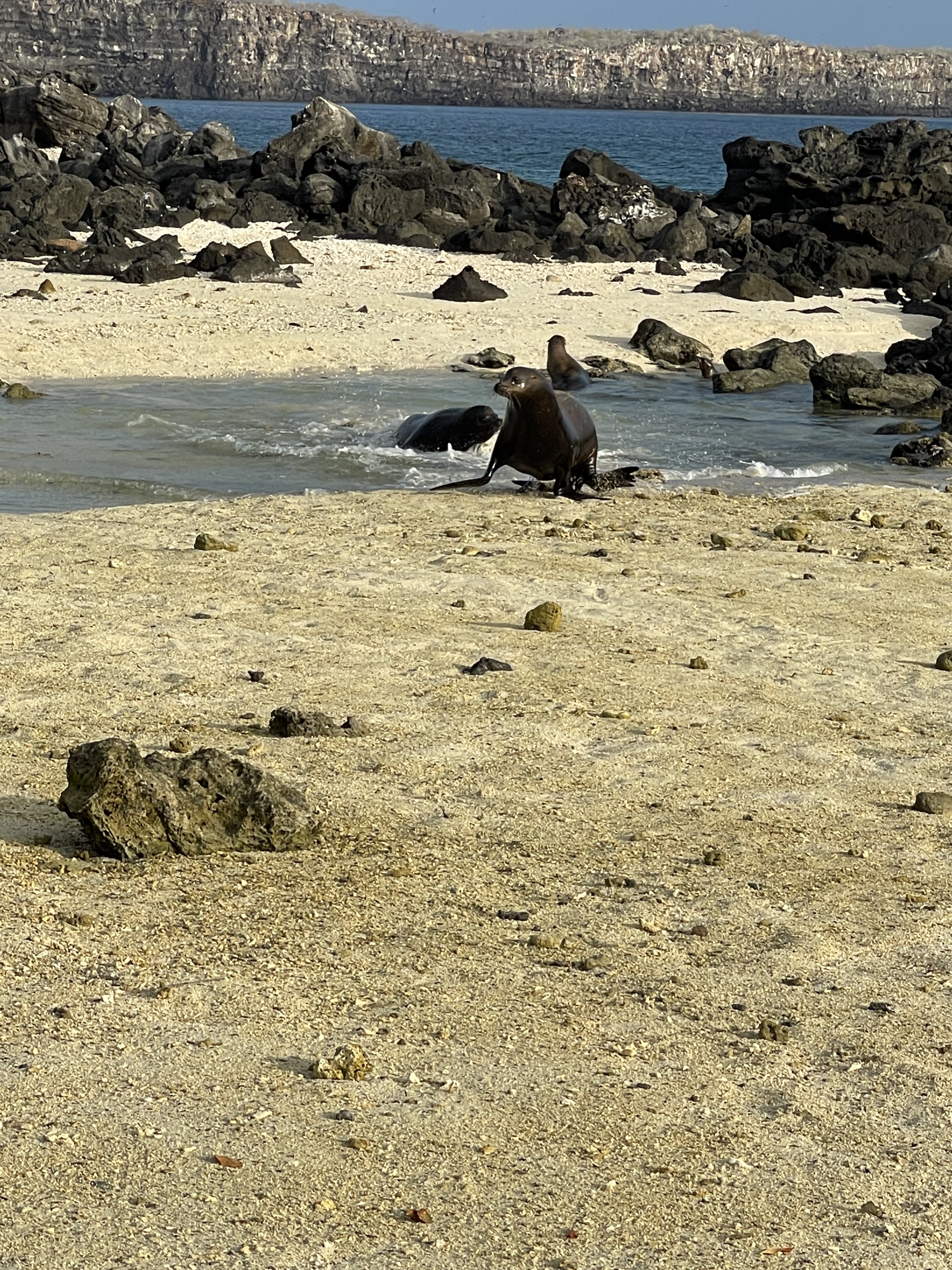
We meet up with David and Linda in the ship’s expedition staging area and wait for our panga to take us ashore for our first WET landing of the cruise. Onshore we find that we have to share the beach and swimming area with some shorebirds and sea lions. Linda is particularly sharing when a sea lion swims out of the water and makes a beeline charge directly at her and her belongings.
Mmmm...ceviche!
She scrambles away to avoid the encounter only to have the sea lion come at her again a short time later. Hopefully, the next time she won’t wear that Essence of Fish perfume! We do a little more swimming and relaxing before taking a panga back to the ship for lunch.

A staple of Peruvian and Ecuadoran diets, lunch features a different type of ceviche every day, and Capt. Larry has sworn to try them all. The meal is buffet style or menu order depending on the diner’s preference, but so far we haven’t seen the offerings as being exceptionally inspiring.


After lunch everybody returns to their cabin for a nap, but Capt. Larry attends a lecture on “Nature Photography” presented by the ship’s filmmaker. Later in the afternoon we again board a panga and return to shore for a Darwin Bay nature walk.

Leaving the beach area it is easy to see why this islands sometimes referred to as Bird Island, as there are literally birds everywhere.

Red-footed booby

Driving Jr. off
We are introduced to our first member of the booby family—the red footed booby. These are the smallest of the boobies in the Galapagos, but the most numerous with an estimated population of over 130,000 pairs. They are easily recognized by their bright red feet, blue beaks and colorful faces. We also see lots of male great frigate birds with their distinctive red gular pouch which they inflate during the breeding season to attract females. And it must’ve been breeding season because they all had them inflated!
Great frigate birds and one with collapsed sac

Our guide told us that one male we spotted with a deflated pouch was due to a wound incurred in a fight with another male. These birds have wing spans of up to 7 ½ feet—the largest wing area to body weight ratio of any bird. Other birds our guide pointed out were Nazca boobies, storm petrels, swallow-tailed gulls, brown pelicans, and Darwin’s finches. Just as our nature walk was about to end, we witnessed two bull sea lions get in a fight, probably over females or territory.
Sleeping sealion

After a couple of minutes of fighting, it became apparent that one dominant alpha male was going to prevail over his challenger and wasted little time in chasing Junior off.

Back on board the ship, we cleaned up and met in the lounge for pre-dinner drinks which flowed into the day’s recap and a lecture on the geology of the Galapagos.

Ship's staff
Our expedition leader then gave us a destination briefing discussing tomorrow’s activities in North Seymour and Santiago Islands. The briefing was followed by a captain’s welcome toast and introduction to the ship’s staff. We enjoyed dinner with David and Linda and then decided to call it a day.


Monday, July 10, 2023

Finally! We Make It to the Galapagos Islands

April 1: Day 9. We are up at 0130 hrs. to get our bags out at 0200 for a 0215 departure. It’s hard to imagine that we are moving again after about 3½ hours of sleep.

Our plane on the San Cristobal runway

Breakfast is served in a brown paper bag that we eat on the bus as we ride to the airport. Once again we have a long way to drag our luggage from the parking lot to the airport lobby, but at least it’s not at altitude. The Lima airport is always busy and there are long lines at both the ticket counter and the security checkpoint.
Ready for the Galapagos Islands!
Our group gets to our gate about an hour before our 0705 departure to Quito.

Arriving in Quito, we pass through immigration and are waved through customs which surprises us, given that this is a different country. In any event, we board our next plane that will fly us to Guayaquil where we will catch a flight that will take us to the Galapagos island of San Cristobal 600 miles off the Ecuadorian coast.

Beautiful island landscape
 It will be another busy day dealing with airports and airlines.

Our flights go smoothly and we arrive at the San Cristobal airport early afternoon. San Cristobal is the easternmost and second most populated (~6000) island of the archipelago.

Boarding a panga

Geologically it is the oldest of all the islands and is comprised of three or four fused extinct volcanoes. Aside from being home to the archipelago’s only major airport, the island is home to the port town of Puerto Baquerizo Moreno, the second largest town in the islands (pop. ~5400) and the government capital of the Galapagos Province which includes the entire archipelago.
We made it aboard!
The airport has a single runway with a cul-de-sac turnaround at one end for taxiing to and from the terminal. Inside the terminal we wait in line while Marcos passes out our entrance passes to the park. The entire archipelago makes up the Galapagos National Park and Marine Reserve. After processing our passes, we board a bus that takes us to the island’s port.

Donning life preservers, we board inflatable zodiac boats (also called pangas by the locals) that take us to our ship— the Silver Sea Silver Origin.

Kicker Rock

We will spend the next 7 nights aboard this expeditionary-style yacht cruising the islands. We are greeted aboard with a champagne welcome and orientation briefing followed by a lifeboat drill and lunch. We spend the afternoon unpacking our luggage and getting ready for the Captain’s welcome reception and dinner. We join David and Linda in the Observation Lounge for a Kicker Rock sunset sail away and pre-dinner drinks.
Kicker Rock at sunset
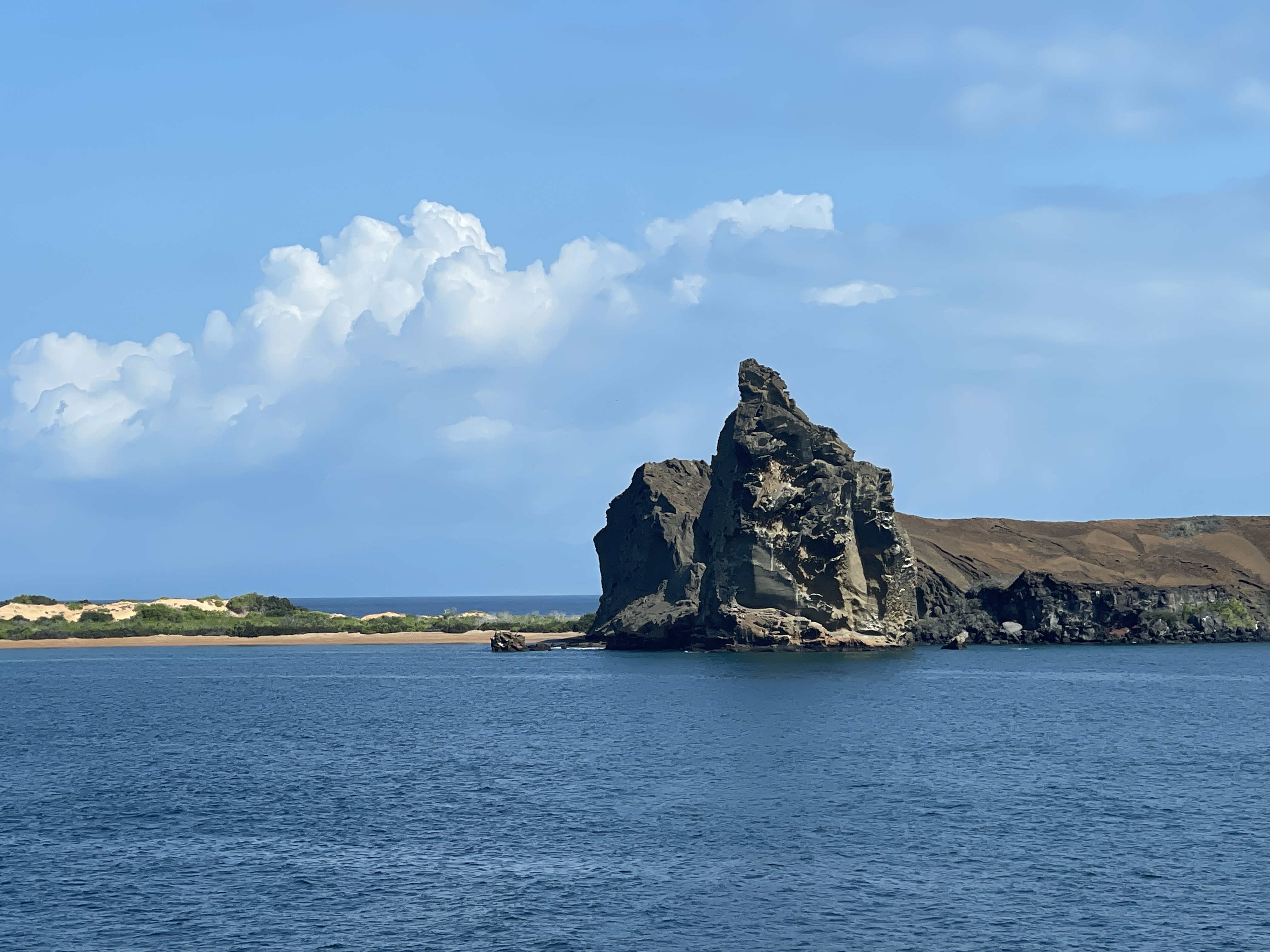
Kicker Rock (also known as Leon Dormido) is the remains of a volcanic tuff cone which forms when hot magma meets cold seawater and the resulting explosion forms a rocky monolith. Over time erosion has split the rock in two. The rock is an extremely popular snorkeling and scuba diving site and is one of the most photographed landmarks in the Galapagos. We enjoy our sunset views of the rock as we circumnavigate it before going to dinner. After dinner, we attend a destination briefing on the activities we will experience tomorrow on Genovesa Island then retire for the night.


Sunday, July 2, 2023

We Spend a Long Day at the Lima Airport

March 31: Day 8. We have an early start to our day not knowing that the day would turn out to be truly hellish and perhaps the worst day we had ever experienced on a tour. We are up at 0300 hrs. with bags out at 0400. Our early departure is to catch a flight back to Lima with a connecting flight to Guayaquil, Ecuador, where we will spend the night before flying to the Galapagos Islands and embark on our ship for a 7–day cruise of the islands. We have breakfast, board our bus, ride to the Cusco airport, and lug our bags into the airport lobby while gasping our last few breaths of the thin air. The flight from Cusco to Lima was unremarkable. We get to the gate for our connecting flight to Guayaquil and wait. It’s getting close to when we should be boarding, but there is no plane at the gate. An announcement is made that we have a last-minute gate change with our new gate at a lower level (meaning we will be boarding using air stairs). We wait some more. And some more. It’s becoming obvious that our flight is seriously delayed. Our tour director, Marcos, is working the ticket counter when the announcement is made that our flight has been canceled. The plane has some major issue that can’t be worked out. We will have to get to Guayaquil on a later flight, but with a group of 20 there are no guarantees that seats will be available.

Around 1100, Marcos asked for volunteers to fly to Guayaquil via Panama, while the remaining group would get there via Quito. Around noon he reappears with the news that the plan fell through. He gathers our group and explains the situation to us. Since he will have to spend time working things out with the airline, he gives us food vouchers that are good in the airport’s food court so we can have lunch. The food court offers a number of dining options, but our vouchers are only good at Burger King, KFC, and a pizza place that is offering up some of the tiniest individual pizzas we have ever seen. KFC is also ruled out because of the long line waiting to get chicken (in fact, almost every Peruvian eating in the food court is feasting on fried chicken and we had noticed that KFC must be the preferred fast food fare due to the ubiquitous outlets we had seen throughout the city). That left us ordering Burger King.


We finished our meal and gathered with other members of our group to wait for news of our flight. Bored to tears, we wait until around 1700 when Marcos appears and announces that we won’t be able to fly tonight and will have to spend the night in Lima. We have been booked on an early flight to Quito tomorrow with a connecting flight to Guayaquil. The main problem centers around getting to Guayaquil in time to board the ship before it sails. If we miss the sailing, we will miss 3 days of the cruise until the ship arrives at an island that will accommodate embarkation. It’s been a long day and everyone is starting to show irritation at the wait time and situation.

Marcos has arranged for a bus to take us to our hotel for the night, and we are forewarned that the hotel is not in the same class as those in which we have been staying. Once again we have a 100-yard trek to the parking lot to board the bus and our luggage is not getting any easier to handle. But at least it’s not at altitude! We leave the airport, which is on the northern outskirts of Lima, and ride completely through the city to its southern outskirts and our hotel. The nearly 1-hour bus ride and the mediocre accommodations of our hotel start to get a few tempers boiling. We are served a nondescript meal and told that we have a red-eye flight to Quito, so there will be another early start tomorrow. A lot of campers are not happy, but it is what it is.