Saturday, June 22, 2013

Kenai Fjords National Park and Plan B


The journey to Seward was about 3 hours long through mountain passes near the coast. We wound our way to the little town of Moose Pass, population 187, that the Milepost says is noted for its Solstice Festival, and we were disappointed that we were so close to timing this event with our schedule, missing it by one day.
Lunch by Upper Trail Lake
We saw some beautiful lakes as opposed to the rivers and creeks we had been seeing, always with a mountainous backdrop. We stopped at one such lake, Upper Trail Lake, had a picnic lunch, then drove on to Seward. When we arrived in Seward we still had some time before checking into our lodge, so we decided to visit the Kenai Fjords N.P. visitor’s center and get the stamp, before entering the park the next day. We drove to where we would check in for our boat ride into the park then headed to our lodge to check in. Once again we found that someone was looking out for us and were upgraded to their deluxe accommodations (maybe we just spent too much money and everyone is feeling guilty!).

The next morning we went to the Kenai Fjords Glacier Lodge office to register and meet our boat for a 4 hour ride into the park. Plan A was to take this boat trip, spend a delightful night at the lodge, and return vibrant and ecstatic the next day.
Seward Harbor
We followed Plan B. Our boat was an estimated 45’ all-aluminum catamaran with twin diesels and an enlarged pilot house and flybridge with bench seating for the passengers and enlarged windows for viewing the scenery.
On our way
Capt. Larry judged it to be a very seaworthy vessel. We registered in the office then parked the car in a municipal parking lot, paying $20 for a 2-day parking fee. After boarding the boat, the captain and first mate gave us an orientation and reviewed the safety procedures. Off we went out of the Seward harbor and into Resurrection Bay. Resurrection Bay got its name from a Russian captain in the late 1700’s when he discovered it while seeking refuge from a storm on the Russian Orthodox Resurrection Day.
Not looking good
Our trip to the lodge was going to be centered around spotting wildlife, and we were no more than 10 minutes from the harbor when we spotted a sea otter. The sea otter population was almost decimated by early fur traders for its prized pelt.
A sea otter
Sea otters do not insulate themselves with a layer of blubber like many other arctic marine mammals, but have a very dense, up to 700,000 hairs/square inch, fur that traps insulating air. We moved on and Capt. Larry started to hear all kinds of chatter on the VHF radio. The trip through Resurrection Bay would be about 20-25 miles and then we would be in the open Gulf of Alaska while rounding a cape that would put us in the next protected bay to the west. We were close to open water when the seas started to get really confused.
Heading for the islands
There was a southeast wind that was pretty strong and Capt. Larry guessed that the tide was going out about this time, based on his observation at Lake Clark two days earlier. This sets the stage for some uneasy seas and we were in 4 foot swells within the next 15 minutes.
Heave ho here!
Based on the reports from other boats, the captain made a decision to head for some islands to the east and look for calmer waters in their lee. He announced what he was doing and said that we would see if conditions improved with a change in the tide. It took us about 25 minutes to get to those islands, and it was hell. Going into more open water, we were now being met with 6 footers, and people started to get sick. They were encouraged to heave off the stern of the boat and were promised a prize for whoever heaved the furthest! But things continued to deteriorate and we were slamming into definite 8 footers. We thought that maybe we were filming a segment of The Deadliest Catch! When you are in the trough and there is a wall of green water in front of you and you see no sky, you know things are bad. The bow pulpit went underwater several times, and while we were uncomfortable, we felt safe. At one point Capt. Larry looked out the back at 6 passengers contributing chum to the ocean, and none of them had a life jacket on. Why the captain allowed this is a mystery.

We made it to the islands and things did settle down. There were several other boats scattered among the islands doing the same thing we were. Someone spotted a pod of orcas or killer whales and all the boats congregated to see.
Female orca
Female orcas are the largest with the males being smaller. We saw 3 dorsal fins, a very large one, a medium-sized one, and a little small one that first mate said was a baby. We watched them for a while them moved on to look for other wildlife. At this point Capt. Larry told Jane that he didn’t think they were going to make it to the lodge.
Orca up close
Another boat that left 2 hours earlier did make it around the cape, but lost one of their encapsulated life rafts in the process. The captain expressed a look that this validated is already determined decision not to go out. We looked for some more wildlife and spotted a humpback whale in the distance. Because they can stay underwater for 15-25 minutes and cover a lot of ground, it is hard to tell where they will surface and get a photo. We did spot it 4 times and one time it fluked us, but it was impossible for us to focus and shoot a picture. We (some of us, anyway) had lunch, and the captain announced that we would not be going to the cape but would be returning to Seward.
Cave used in WWII
Although we were disappointed, we both knew it was the correct decision. We headed back in calmer, protected waters gunkholing in little coves, while looking for wildlife. Seward is the northernmost ice free port and was important logistically during WWII. For this reason you can spot caves and bunkers along the bay that protected the port from possible enemy invasion.

When we returned to Seward, we were given an option of staying at a sister lodge or getting a refund. Many of our group had signed up for a 2-day trip into the park and elected to be housed in the sister lodge and try again tomorrow. We didn’t have the option of another try, but we initially elected to be housed overnight and then resume our schedule tomorrow.
Jane and a harbor seal
When we learned that the sister lodge was 1½  hours away, we thought a full refund would be best. The management did try and make things right and offered everyone free admission into Seward’s Alaska Sea Center. We tagged along with the group and visited the center before leaving for our lodge.
Glacier recession since 1951
Although we didn’t get to stay at the lodge in the park, we were within the park boundary while on the water. But to really cement a visit to the park we decided to visit the park’s Exit Glacier which was 8 miles from our lodge and accessible by car the next day.
Taking a break at Exit Glacier
When we got to Exit Glacier we visited the visitor’s center and got that center’s park stamp (naturally!). Then we hiked about ½ mile to a viewing point to see the glacier. As you enter this part of the park, there are signs along the road and walkways that show the limit of the glacier for that year and illustrates the glacier’s recession. We found a sign labeled “1951,” the year Capt. Larry was born. We took a photograph of him in front of the glacier today which demonstrates how far the glacier has receded in his lifetime. We returned to our lodge for another night before heading onto our next park.

And that was our trip to Kenai Fjords, N.P.!

Alaskans love their big dogs

Friday, June 21, 2013

In the Heart of Bear Country- Lake Clark, N.P.


The next day we had such a wild and action-packed day on our trip to Lake Clark N.P. that we don’t know where to begin. It all started with our arrival at the Soldotna Airport for our 0730 departure on a Natron Air bush plane.
Our plane to Lake Clark
Jane was nervous about the flight, but kept her comments to a minimum after we had “the talk” the night before.
Jane's world
We were flying over with another couple from Fargo, ND and Capt. Larry had lots to talk to them about since he lived nearby in Minnesota.
High over the Cook Inlet
The plane left promptly at the departure time and the pilot was so smooth in handling the plane that Capt. Larry was quite impressed. Jane was in her own little world, kind of like crossing the Gulf of Mexico on the boat trip! After we got over the Cook Inlet, the mountain scenery on the eastern shore was spectacular.
Landing on the beach
We approached the park and heard the pilot announce that we would be landing at the north airport runway. He banked sharply to the right as he descended and Capt. Larry figured that Jane was having a private moment in her panties.
We're all smiles back on the ground
Capt. Larry was looking for an airstrip when he realized that the plane was going to land directly on the beach and the pilot was just being cute. Bush pilots have a way of cutting the engine while the plane is still rolling which didn’t amuse Jane. We came to a stop and our greeting party had to fire up their 4-wheelers to catch up with us.
Alaskan Homestead Lodge
We got out and loaded our bags into the ATV caravan and headed out to Alaska Homestead Lodge in beautiful Lake Clark, N.P.
The "caravan" from the beach
We found out the Alaska Homestead Lodge is really first class accommodations and are priced starting at $650/night/person (we think that includes the airfare), and of course is all inclusive as there is no place else to eat. You can check out their website at this line- http://alaskahomesteadlodge.com/index.html . We were delighted when we were upgraded (again!) to the Eagle’s Nest. This is a room above an old trapper’s cabin that has a private balcony, bath (yes, that is a luxury in Alaska!), and a beautiful view of a meadow and eastern shore of the Cook Inlet. We were delighted!


The first order of business was to load back up in the four wheelers and head out for some bear viewing. Bear viewing has become the number one attraction for the businesses and lodges in Lake Clark, N.P., because so many exist.
The caravan to the bears
We jumped in the ATV-caravan and Capt. Larry immediately knew she wasn’t prepared for this. She had all of her jewelry, make-up, and good clothes on and we had to wait on her to appear while she fixed her hair!
Our first encounter
Off we headed across the meadow to a spot where our guide “Bear” (yes, really, but his name is Barrett Hedges) had sighted a big old sow earlier. Along the way we ran into a fairly big (650-700 lbs.) male that made us stop and take pause.
The bears are breeding this time of year and the males are particularly aggressive (nice to know).
Getting a leeeetle close!
The male finally wandered into the tree line, so we parked the ATV and headed out on foot to find the female. Jane muttered something about not having the right shoes….  We found the old girl and watched her as she slowly made her way in our direction.
The ranger and the captain
It was obvious (to Bear, anyway) that she wasn’t upset by humans and she exhibited no aggressive behavior. The first time you do this you start to get uneasy, especially when they get within 25-30 yards of you and you know they can cover that distance in the blink of an eye. We spotted many more bear that morning, and while we were viewing, the park ranger came up with our backpacks that we had left in the ATV. She warned us that bears love to chew on polyester and the backpacks were not safe in the ATV. We asked her if she had a Passport stamp for the park and she indicated that she did. She said that she would bring it over later so we could collect it.
Lunchtime
It was the first time we got delivery service on a national park stamp. Capt. Larry posed with her and thanked her for getting the stamp for us. She is one of 8 park rangers on a park that covers 4 million square miles and was a real sweetheart. We continued to watch the bears. There were males and females, but no cubs. What is interesting is the variety of color that they exhibit.
A big (~700 lbs.) male print
Big males tend to be dark brown, and the females have a variety of almost blonde coloring. We chased all over the meadow and Bear was really good at spotting them for use. It was lunchtime and we returned to the lodge to enjoy our first meals. We met a German couple from northern Germany and struck up a great conversation with them.
Dark male mating a lighter female
We also enjoyed the company of the couple from ND. We headed out for some afternoon bear viewing, not something Jane really wanted to do, and were rewarded by a male chasing a female for quite some distance. We followed to see how it would turn out and when they felt they were far enough away, she stopped and he mounted her and they began mating.
Cooling down after mating!
The old bear was really something as this went on for over 25 minutes. When he was through, he got down and wandered off while the female lay down prostrate in a stream cooling her belly. She was smokin’! We thought that would be the highlight of the day, but it got better. Bear spotted a female that he said was “ditzy” with a couple of yearling cubs.
Mama and 3 month old cubs
The talk of the camps was that the day before she tried to cross the deep, fast flowing, Johnson River. Her young cubs followed, but immediately got into trouble as they were no match for the stream conditions.
Nursing her cubs
One of the guides witnessed that one of the cubs almost drowned until she came back and rescued it. We the three of them were on the other side of the river again as we approached. She acted like she wanted to cross, but the cubs would have not part of it. As we got opposite of them, she lay down and we got to see something else many don’t. R
Whose out there?
ight there about 40 yards away she started nursing both cubs. We watched that for a while and then the bears settled down for a nap. We waited a long time waiting for them to get up before moving on. We got to a new spot and here comes the three bears we’d been watching.
Bear at work
Guess they wanted to pose some more. This was where our guide, Bear, revealed his true colors. He whipped out his camera and lens making Capt. Larry really feeling inadequate. He hadn’t said anything up to now, but everyone was quizzing him. Turns out he graduated with a degree in photography from the Carson-Newman College in eastern Tennessee.
The kids horsing around
He considers himself a professional bear photographer (that’s all he wants to photograph) and has the credentials to back it up. He won the 2010 National Geographic Photo Competition with an awesome shot of a bear charging toward him, which he says was actually after a salmon (yeah, right!). This shot beat out 14,000 images that were submitted for the grand prize competition. You can check out his website and see some of his beautiful photography at this link- http://www.bearheadphoto.com/ . We all took several pictures of the bear cubs fighting and interacting. It was quite a revelation and something to watch him at work. He gave Capt. Larry some pointers, Millette!


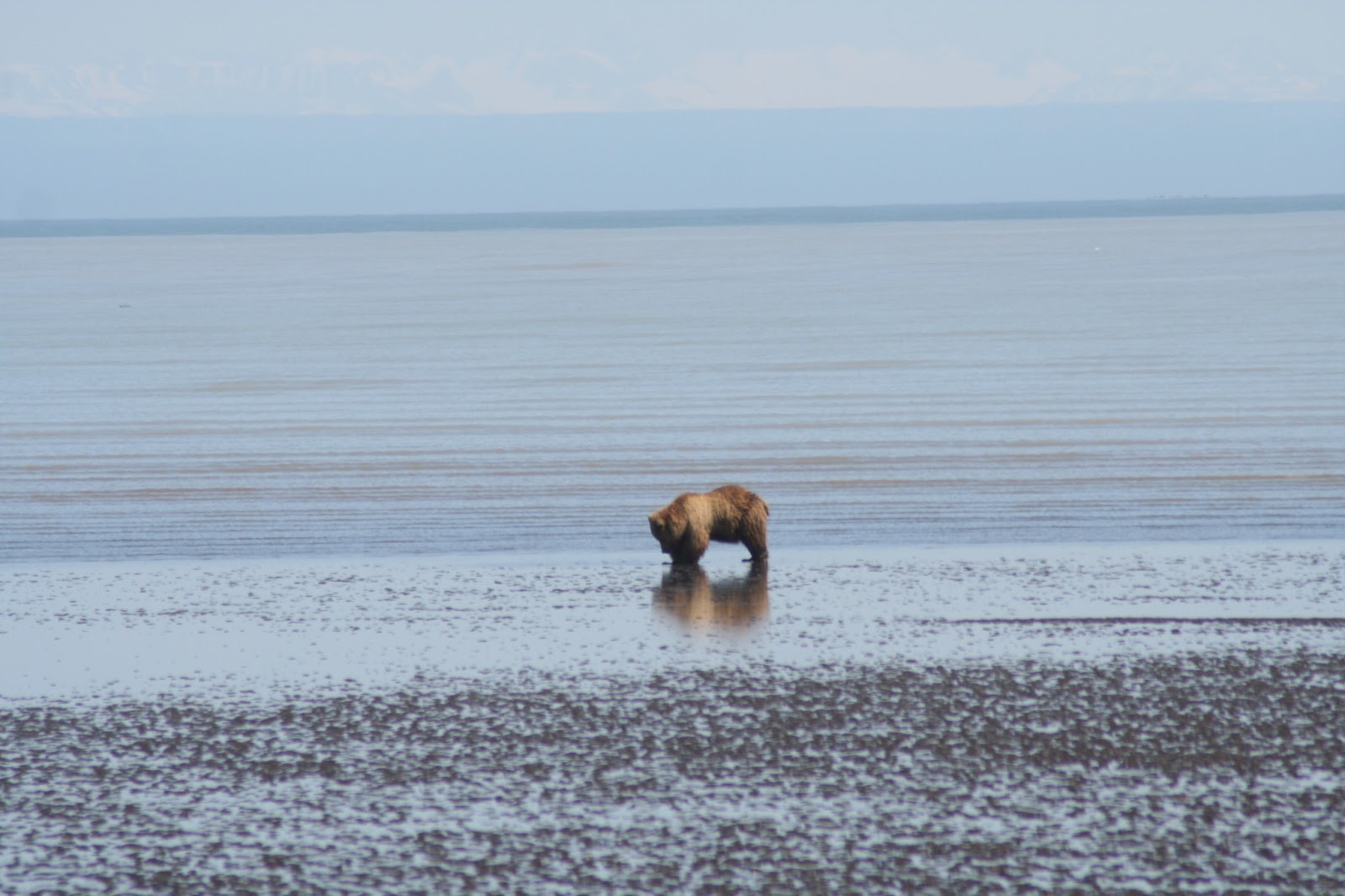
We headed back toward the lodge and noticed 3 bears out in the tidal flats. It was low tide (semi-diurnal tides with a 27-30 foot tidal range!) and they were digging for clams. This time of year bears emerge from hibernation and will eat anything.
Digging clams for lunch
They prefer salmon and meat, but not much of those food sources are available so early in the year. They are opportunistic eaters eating mostly sedge grass, but will dig for clams if they can get them. Interestingly, the bears along the coast are considered brown bears and not grizzlies which are found further inland.
It's what's for dinner!
Brown bears are larger because of their almost exclusive diet of salmon, while grizzlies eat other meat sources and don’t grow as large. In any event, the bears we saw were very large. We stopped while Bear disappeared over a sand dune.
Some lodge decor
He came running back and announced that a male, he referred to as “big daddy,” was chasing a female. Sure enough he had no sooner made in back to the ATV when here comes the female on a dead run or lope with the male in hot pursuit.
Jane in the bear door
Both of them were oblivious to our presence which we considered a good thing! We returned to the lodge and started to get ready for dinner. On the way back we stopped by to check on the lodge’s success with a set net, much like a gill net, which they used to catch salmon for dinner.
A stamping ceremony
We learned that they can catch an unlimited number of fish for personal consumption two days a week (Tuesdays and Thursdays which expands to daily when the season is in full swing). The lodge owner, James, only had one fish to show for his effort, but he promised that it would be on the table for dinner tonight.
A wonderful dinner
After a welcome shower (riding the bear trails can be quite dusty due to the lack of rain they’ve received) and some before dinner drinks, we settled down to a salmon, pasta, and salad dinner that was absolutely delicious. We interacted with the cook staff.
Where does a 700 lb. bear go?
The chef was from Las Vegas and the assistants were local, and we had a great time until we were interrupted with male bears chasing female bears through the yard. It was fun to watch these antics and we watched until we realized that we were just plain weary of anymore bear watching. We tried to stay up and enjoy our beautiful and balcony, but all of that bear watching totally exhausted us. We turned in for the night and immediately fell into a restful sleep.


The next morning we arose to a delicious breakfast of eggs, sausage, and blueberry pancakes. Compliments to chef. Bear drove use to the beach to wait for our plane. The plane arrived on time and we boarded and took off from the north airstrip (the beach). We arrived back in Soldotna, picked up our car and headed toward Seward, the next leg of our adventure.

Bear and Jane

Tuesday, June 18, 2013

Cruising to Soldotna


Along the Seward Highway
We left Anchorage the next morning, Father’s Day, after Capt. Larry was surprised by timely calls from both of his boys with Father’s Day well wishes. And Jane’s daughters also sent their greetings. Things are looking up to be a great day! We started our day by heading down the Seward Highway and then taking the Sterling Highway to Soldotna.
Breathtaking views
The Milepost said that most people considered this stretch of road to be the most scenic in Alaska. We couldn’t disagree as the scenery was absolutely stunning.
View by the Seward Highway
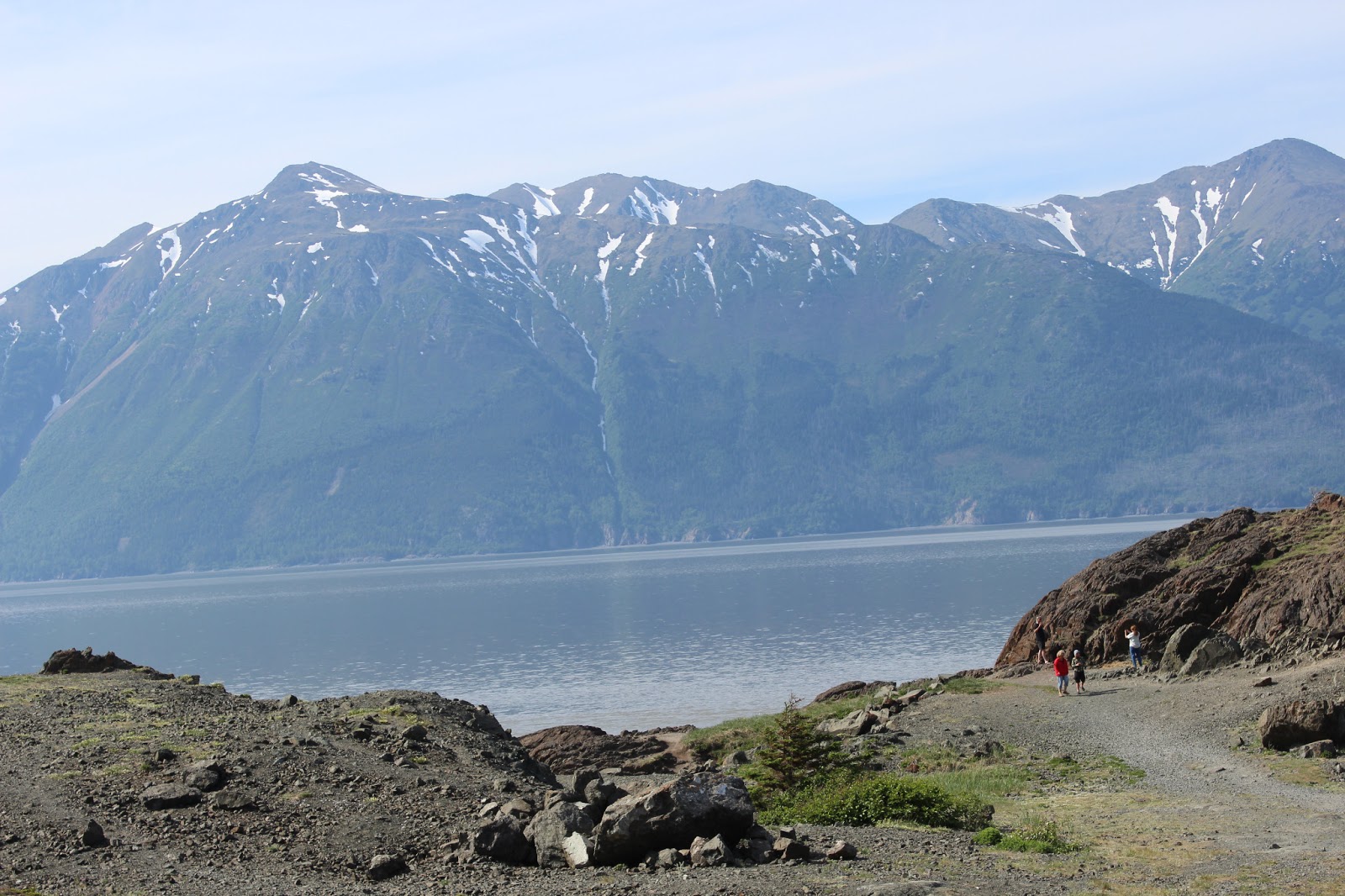
The road pretty much followed the eastern shore of the Cook Inlet with beautiful water shots with mountain backdrops.

Signs at Beluga Point

Beluga whales are often sighted in this section of the inlet and we were hopeful that we would spot some. We stopped at Beluga Point which seemed to be the logical place to spot them, but after scouring the water with our binoculars for about 20 minutes and observing that no one else there seemed to be spotting anything, we moved on. In many spots the inlet comes right up to the road and provides some spectacular views, but we repeat ourselves.
More gorgeous scenery
One of the interesting geological events that forever reshaped the Alaskan landscape was the “big” earthquake on Good Friday, 1964.
This was a huge earthquake, one of North America’s largest, measuring 9.2 on the Richter scale.
Dead trees from the earthquake
By comparison, the Great San Francisco Earthquake of 1906 is only evaluated at 7.9, and remember, this is a geometric scale, so a little increase in scale produces huge devastation. What this earthquake did along the Cook Inlet coast was drop coastal terrain about 40-50 feet. This resulted in this landscape suddenly being inundated with salt water and killing all of the trees and plants. Evidence of this occurrence can still be seen today with a number of dead trees next to the coast. It was cool to be able to see this.


On the banks of the Kenai River
We came to the junction of the Seward Highway and the Sterling Highway and turned west. We stopped in Sterling for a break, but there wasn’t much to experience. We moved on to Soldotna where we would spend the night, and it turned out to be a nice sized town with a lot more businesses than Sterling. This made us wonder why they called it the Sterling Highway.
At the Soldotna visitor's center
We found our hotel which turned out to be a first class accommodation (someone was looking out for us!) and then checked in with the “bush plane” people to verify that we were in town and needed flight service over to Lake Clark, N.P. the next morning. We went to the Soldotna visitor's center to get the local scoop, then wandered by the banks of the Kenai River, a heavily fished salmon king salmon river, for a few photos. After that and being Father’s Day, Jane took her captain to dinner. We had a great evening and got our bags repacked for our short excursion into Lake Clark.


Happy Father's Day Opa and Capt. Larry